







































































Historical Accounts of Ardh Kumbh Pilgrimages
Ancient travelers, medieval records, and colonial accounts of Ardh Kumbh. Discover how history documented the world's largest pilgrimage through centuries.

The Deepest Roots: Megasthenes and the 4th Century BCE
The earliest possible reference to a gathering like the Kumbh comes from a surprising source — a Greek ambassador named Megasthenes, who lived at the court of Chandragupta Maurya around 300 BCE . Megasthenes wrote an account of India called the Indica, now lost but quoted by later historians. In it, he described a great festival held every twelve years at the confluence of rivers, where hundreds of thousands of pilgrims gathered for ritual bathing and trade. He mentioned that the festival lasted for seventy-five days and was attended by people from all over the subcontinent . Historians debate whether this was definitely the Kumbh as we know it today, but the similarities are striking. A twelve-year cycle. A river confluence. Massive crowds. Pilgrimage and commerce side by side. If Megasthenes was indeed describing the Kumbh, then this tradition is over 2,300 years old. That means when you stand in the queue at Har ki Pauri, you are standing in a line that stretches back to the time of Alexander the Great. That is not just a pilgrimage. That is a civilizational memory.
Xuanzang's 7th Century Account: A King's Generosity
The most detailed early account of a Kumbh-like gathering comes from Xuanzang (also spelled Hiuen Tsang), the Chinese Buddhist monk who traveled across India between 629 and 645 CE . Xuanzang visited Prayag (modern Prayagraj) during the reign of King Harshavardhana, one of ancient India's greatest rulers. He describes a grand assembly held every five or twelve years on the banks of the Ganga and Yamuna, where the king distributed all his wealth to the pilgrims — monks, brahmins, the poor, and the needy . Xuanzang writes that the king would give away everything — his gold, his jewels, his clothes, even his own royal ornaments — and then borrow clothes from his sister to wear back to his palace. This was not just charity. This was a royal ritual of renunciation that echoed the spiritual core of the Kumbh. Xuanzang estimated the crowd at around half a million pilgrims . He was told that this gathering had "gone on since ancient times" . His account is the first clear, datable, eyewitness description of a massive pilgrimage fair at one of the Kumbh sites. For historians, it is the anchor that proves the Kumbh tradition is at least 1,400 years old — and likely much older.
The Name Appears: Persian Records of the 1690s
For centuries, travelers described the fair without using the name Kumbh Mela. That changed in the late 17th century. The first known text that explicitly uses the term "Kumbh Mela" is the Khulasat-ut-Tawarikh (1695 CE), a Persian chronicle of the Mughal Empire written by Sujan Rai . This text describes the fair at Haridwar in detail. It states that every year when the sun entered Aries during Vaisakhi, people from nearby areas would assemble. But once every twelve years, when the sun entered Aquarius (Kumbh in Sanskrit), people from far away would come . The text specifically calls this the "Kumbh Mela" and notes that bathing, giving alms, and shaving one's head at this time were considered acts of great merit. It also mentions that lakhs of laypeople, faqirs, and sanyasis attended . Another Persian text, Chahar Gulshan (1759 CE), confirms this, stating that the Haridwar fair was called Kumbh Mela and that it attracted enormous crowds . These Mughal-era records are crucial because they prove that by the late 17th century, the Kumbh was already a well-established, named, and widely recognized institution.
The Original Kumbh: Why Haridwar Came First
An interesting question emerges from these early records. Why do the oldest mentions of the name "Kumbh Mela" refer specifically to Haridwar, not Prayag? Historians believe that Haridwar was likely the original Kumbh Mela site . The reason is astrological. The name Kumbh itself comes from Aquarius (Kumbh rashi). The Haridwar Kumbh is held when Jupiter enters Aquarius — a direct astrological link to the name . The fairs at Prayag, Ujjain, and Nashik were probably earlier regional festivals — the Magh Mela at Prayag, the Simhastha at Ujjain and Nashik — that were later rebranded as Kumbh Melas to align with the more famous Haridwar event . This does not make them less ancient or less authentic. It simply means the brand "Kumbh Mela" spread from one site to others over time. By the 18th century, all four sites were firmly established in the Kumbh cycle, with Ardh Kumbh at Haridwar and Prayag held every six years between the full twelve-year Kumbhs .
Trending Guides Now

Who Are Naga Sadhus and Why They Lead Kumbh
Read Guide →
Significance of Bathing in the Ganges During Kumbh Mela Explained
Read Guide →
What Is the Story Behind the Ardh Kumbh Mela?
Read Guide →
The Untold Stories of Har Ki Pauri
Read Guide →
Ardh Kumbh 2027 Dates (Official) - Haridwar Snan Schedule
Read Guide →
Dharamshala Stay During Ardh Kumbh: Free & Budget Guide
Read Guide →
Official Progress Report of Haridwar Ardh Kumbh 2027 Infrastructure Projects
Read Guide →
Where to Find 24-Hour Pharmacies in Haridwar During Ardh Kumbh 2027 Emergencies
Read Guide →Violence at the Sacred Fair: Akhara Clashes in the 18th Century
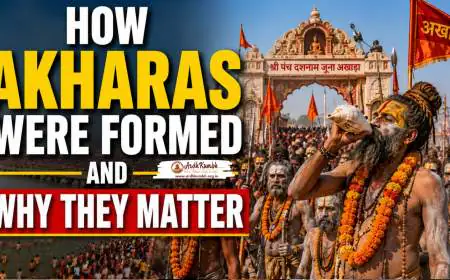
Not all historical accounts paint a peaceful picture. The Kumbh has also been a site of violence, particularly between rival akharas of sadhus. The earliest recorded clash is from 1640 CE, mentioned in the Persian text Dabestan-e Mazaheb, which describes a battle at Haridwar between competing Shaivite and Vaishnavite ascetics . The most famous and bloody incident occurred in 1760 at Haridwar. A violent conflict between the Shaivite Gosains and the Vaishnavite Bairagis left hundreds — possibly thousands — dead . An 1808 account by Captain Francis Raper of the East India Company claimed 18,000 Bairagis were killed, though this number is likely exaggerated . Another massacre took place in 1796. The Udasi ascetics, accompanied by 12,000 to 14,000 Sikh cavalrymen under the command of Sahib Singh of Patiala, attempted to plant their flag at the festival site without permission from the dominant Gosain sect. When the Gosains resisted, a full-scale battle erupted. The Sikhs attacked the Gosain camp, killing around 500 people, including a senior mahant. The British Captain Murray intervened with his sepoys to stop the fighting . These historical accounts reveal a forgotten truth. The akharas were not just spiritual orders. They were armed militias with trade interests, tax-collecting powers, and political ambitions. The British would later disarm them and take control of the Kumbh precisely to stop this violence.
Epidemics and Tragedies: The 1783 Cholera Outbreak
The Kumbh has also faced public health crises. The most devastating was the cholera epidemic during the 1783 Kumbh Mela at Haridwar . An estimated 1 to 2 million pilgrims attended that year. Within the first eight days of the fair, more than 20,000 people died of cholera . The epidemic was confined to Haridwar itself — the neighboring town of Jwalapur, just eight miles away, saw no cases. The fair continued, and the epidemic ended when the pilgrims dispersed . This tragedy highlighted the public health challenges of mass gatherings long before modern medicine understood how diseases spread. It also demonstrated the extraordinary resilience of the Kumbh as an institution. Even with thousands dying, the pilgrims did not abandon their faith. They stayed, they bathed, they prayed, and many died. This is not foolishness to modern eyes. It is a testament to the power of belief — a power that continues to draw millions despite all risks.
The British Take Control: Colonial Administration of the Kumbh
When the East India Company took control of the Saharanpur district (including Haridwar) in 1804, they inherited a Kumbh that was managed not by any government, but by the akharas themselves . The sadhus collected taxes, policed the grounds, settled disputes, and even maintained armed forces. The British found this arrangement intolerable. They systematically disarmed the akharas, restricted their trader-warrior roles, and reduced them to begging in many cases . The British also introduced modern crowd management techniques. After the violence of 1796, they deployed armed detachments "of greater strength than usual" to keep the peace . In 1808, they prepared to receive the visiting Maharaja Ranjit Singh of the Sikh Empire with full diplomatic honors . The British also began documenting the Kumbh with bureaucratic precision — counting pilgrims, calculating tax revenues, mapping the grounds, and writing reports that are now invaluable historical sources. The colonial period transformed the Kumbh from an akharas-run event into a state-managed one — a change that has largely continued in independent India.
Mark Twain's Wonder: An American Voice at the 1895 Kumbh
The most famous foreign account of the Kumbh from the 19th century comes from the American author Mark Twain. He visited Prayag in 1895 and wrote about his experience in Following the Equator. His words capture the Kumbh with a novelist's eye and a humanist's heart. He wrote, "These pilgrims had come from all over India; some of them had been months on the way, plodding patiently along the heat and dust, worn and poor, hungry, but supported and sustained by an unwavering faith and belief. It is wonderful that the power of faith like that can make multitudes upon multitudes of the old and weak and the young and frail enter without hesitation or complaint upon such incredible journeys and endure the resultant miseries without repining" . Twain did not share the faith of the pilgrims. He was a skeptic, a satirist, a man of the modern West. And yet, he was moved. His account is valuable precisely because he came as an outsider — not to mock, but to witness. He saw what the Kumbh truly is: not just a religious ritual, but a testimony to the power of human belief to overcome every obstacle. His words have inspired generations of pilgrims and travelers since.
The Ardh Kumbh in Modern Records: 1971 to Today
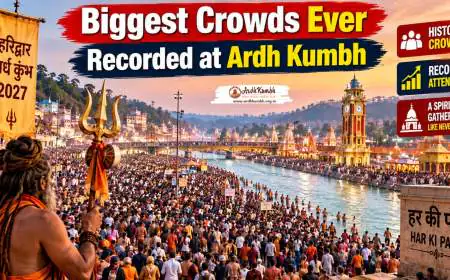
The Ardh Kumbh as a specifically named event appears clearly in records from the 20th century onward. In 1971, the Ardh Kumbh at Prayag was noted in the Times of India, which reported that "about 20,000 pilgrims had a dip... marking the beginning of the one-month Ardh Kumbh" . The 1982 Ardh Kumbh at Prayag saw three million pilgrims on a single day, with a tented township spread over 6,000 acres on the riverbed . The 1992 Ardh Kumbh at Haridwar lasted from February to April, with seven main bathing days . In 1995, Hinduism Today magazine reported on the Haridwar Ardh Kumbh, noting that it was "just a little gathering of 45 million souls" . By 2010, the Ardh Kumbh at Haridwar attracted over 10 million pilgrims on the most auspicious day alone . The 2016 Ardh Kumbh at Prayag continued this trend . These modern historical records show a clear trajectory. The Ardh Kumbh has grown from a regional fair documented in Persian chronicles to a global phenomenon tracked by satellites, news media, and government bureaucracies. And yet, the core remains unchanged. A pilgrim in 1695 and a pilgrim in 2025 both stand in the same Ganga, cup the same water in their hands, and whisper the same prayer.
What the Records Leave Out: The Voices of Ordinary Pilgrims
For all their value, the historical accounts we have are incomplete. They are written by foreigners (Megasthenes, Xuanzang, Twain), by court chroniclers (Persian records), or by colonial administrators (British reports). What is missing? The voice of the ordinary pilgrim. The farmer who walked for two months to reach Haridwar. The mother who carried her infant through the crowd. The elderly widow who spent her life's savings on this one journey. These pilgrims did not write books or leave records. They simply came. They bathed. They prayed. They returned home. And their absence from the historical record is itself a lesson. The Kumbh was never for the elite or the literate. It was always for the masses — the people who do not make history but are history. Every time you stand in a Kumbh queue today, you are standing where millions of anonymous pilgrims have stood before you. Their names are lost. But their faith is not. It flows in the same Ganga that will touch your skin. That is the deepest historical account of all — one written not in words, but in water.
Frequently Asked Questions