




















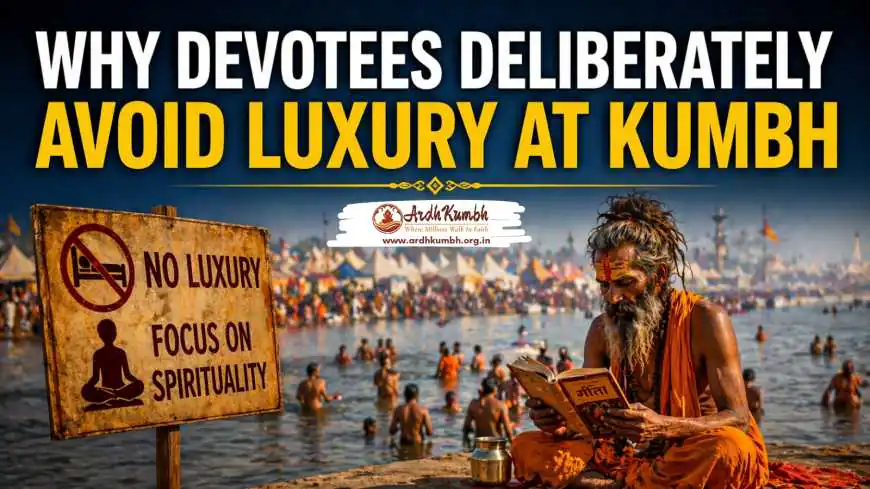
Why Devotees Deliberately Avoid Luxury at Kumbh
5-star hotels are available. Private tents with AC exist. So why do millionaires sleep on the ground? The shocking spiritual reason behind avoiding luxury at Kumbh.
Quick Answer: Why Devotees Deliberately Avoid Luxury at Kumbh
Many devotees deliberately avoid luxury at Kumbh because they consider the pilgrimage an opportunity for spiritual discipline, simplicity, humility, and detachment from material comforts. Instead of focusing on expensive accommodation, premium food, or luxurious facilities, they may choose basic living arrangements to concentrate on prayer, meditation, holy bathing, religious discussions, and self-reflection. 🙏
For some pilgrims, simple living is also a way to practise renunciation and self-control, values traditionally associated with spiritual journeys and ascetic life. Staying away from unnecessary comforts can help devotees experience the gathering with a sense of equality, devotion, and connection to religious traditions. However, avoiding luxury is a personal choice, not a requirement for every visitor. Elderly pilgrims, families, and people with medical or accessibility needs may reasonably prefer comfortable accommodation and essential facilities. At Kumbh, the deeper purpose for many devotees is not luxury or hardship, but faith, spiritual experience, and inner transformation.
1. Luxury Builds Walls; Humility Opens Doors
Here is the first truth. Luxury separates you. When you are in a five-star hotel, you are behind a locked door. You have room service. You have privacy. You are safe, but you are also isolated. The Ardh Kumbh is not about isolation. It is about connection.
When you sleep on the ground in a tent with 50 other people, you cannot hide. The banker hears the farmer snoring. The doctor shares her blanket with a cold stranger. The walls of ego come down because there are no physical walls to hide behind.
Why devotees avoid luxury: They know that luxury whispers, "You are special. You are different." The Kumbh shouts, "You are exactly like everyone else." And that equality is the foundation of true spiritual experience. You cannot buy humility in a store. You have to earn it by sleeping on the ground.
2. Discomfort Accelerates Inner Growth
Nobody likes standing in a line for two hours. Nobody enjoys cold water at 5 AM. But here is the secret that devotees understand: discomfort is a fast-track to inner strength.
Modern life has made us soft. We have air conditioners for summer, heaters for winter, noise cancellation for quiet. We have engineered discomfort out of our lives. But spiritual growth happens at the edge of your comfort zone. When you choose to be cold, hungry, or tired at the Kumbh, you are telling your mind, "I am not a slave to my comfort."
Why devotees avoid luxury: They are not masochists. They are practical. They know that a little voluntary discomfort now builds mental muscles that help them handle involuntary suffering later (illness, loss, old age). The Kumbh is their training ground.
Trending Guides Now

Har Ki Pauri Ganga Aarti Time Today in Haridwar
Read Guide →
Ardh Kumbh Mela Rituals Explained Shahi Snan & Akhara Traditions
Read Guide →
Why Order and Cleanliness Are Strictly Enforced
Read Guide →
Daily Spiritual Practices Only Seen at Ardh Kumbh
Read Guide →
Ardh Kumbh 2027 Dates (Official) - Haridwar Snan Schedule
Read Guide →
Dharamshala Stay During Ardh Kumbh: Free & Budget Guide
Read Guide →
Official Progress Report of Haridwar Ardh Kumbh 2027 Infrastructure Projects
Read Guide →
Where to Find 24-Hour Pharmacies in Haridwar During Ardh Kumbh 2027 Emergencies
Read Guide →3. The "Ego Death" That a King Size Bed Cannot Give
Your ego loves luxury. Your ego loves saying, "I deserve the best room. I deserve VIP access. I deserve to not stand in line." The Ardh Kumbh is an ego dismantling machine. And nothing dismantles the ego faster than sleeping on the floor.
When a millionaire lies down on a railway platform next to a beggar, something shifts inside him. The labels fall away. The bank balance stops mattering. For a few hours, he is just a man trying to sleep. That is ego death—not permanent, but a precious glimpse of life without the constant need for status.
Why devotees avoid luxury: They come to the Kumbh to lose their ego, not to polish it. A luxury tent with a chandelier would feed their ego. Sleeping on the ground starves it. And a starved ego is closer to God than a fed one.
4. Luxury Distracts from the Real Purpose
Let me ask you a question. If you are worried about whether your AC is working, whether your pillow is fluffy enough, or whether your bathroom has hot water—where is your mind? It is on comfort. Not on faith. Not on prayer. Not on the holy dip.
Luxury is a distraction. It fills your brain with trivial concerns. The devotee who avoids luxury frees up massive mental bandwidth for what actually matters: chanting, meditating, serving, and bathing in the sacred river.
Why devotees avoid luxury: They are on a spiritual mission, not a vacation. A vacation is about relaxing the body. A pilgrimage is about awakening the soul. You cannot do both at the same time. The Kumbh is not a resort. Treating it like one means you miss the entire point.
5. Shared Hardship Creates Unbreakable Bonds
Have you noticed that war buddies are closer than office colleagues? Why? Because they shared hardship. The same logic applies at the Ardh Kumbh.
When you and a stranger shiver together in the cold, share a single roti, or walk ten miles in the mud, you are not strangers anymore. Hardship creates a chemical bond (oxytocin, if you want the science). You trust that person because you suffered together.
Why devotees avoid luxury: They want those bonds. A luxury tent isolates you. A community tent connects you. The devotee chooses the community because they know that the friendships made on the cold ground last longer than the memory of a soft bed.
6. The Spiritual Mathematics of "Tapasya"
In Hindu philosophy, there is a concept called Tapasya—austerity, voluntary discipline, spiritual heat. It is believed that Tapasya burns karma. It cleanses the soul. It generates spiritual energy.
When a devotee chooses to sleep on the floor, fast for a day, or bathe in freezing water, they are doing Tapasya. They are not suffering for no reason. They are investing in their spiritual bank account. Every moment of discomfort is a deposit.
Why devotees avoid luxury: They understand the mathematics of the soul. Luxury is a withdrawal (it feels good now, but costs you spiritually). Tapasya is a deposit (it feels hard now, but pays dividends in peace, clarity, and grace later). They come to the Kumbh to make deposits.
7. Luxury Creates Dependency; Simplicity Creates Freedom
Here is a scary thought. The more luxury you have, the more you need it. You get used to air conditioning, and now you cannot sleep without it. You get used to soft mattresses, and now your back hurts on anything else. Luxury is a golden cage. It makes you dependent.
The devotee who sleeps on the ground at the Kumbh is practicing detachment. They are telling themselves, "I do not need a soft bed to be happy. I can be happy anywhere." That is real freedom.
Why devotees avoid luxury: They are training for freedom. If you can be happy on the cold ground, you can be happy anywhere. If you need a five-star hotel to be happy, you are a slave to your comfort. The Kumbh is liberation boot camp.
8. Following the Example of the Sadhus
Look at the Naga Sadhus at the Ardh Kumbh. They wear almost nothing. They sleep in the open. They cover their bodies with ash. They own nothing. And yet, look at their faces. They are often the most peaceful, joyful people at the entire Mela.
The householder devotee (the normal person with a job and a family) sees this and feels a pull. They think, "If these sadhus can be happy with nothing, maybe I don't need so much either." They are not trying to become sadhus. But they want to borrow some of that peace.
Why devotees avoid luxury: Monkey see, monkey do. The sadhus model simplicity. The devotees imitate it, even if just for a few days. It is a respectful nod to a higher spiritual ideal. "If you can do it for life, I can do it for a week."
9. Avoiding "VIP Culture" to Stay Human
We live in a world of VIP culture. VIP lounges at airports. VIP darshan at temples. VIP lines at concerts. It is exhausting. The Ardh Kumbh is one of the last places where VIP culture is actively resisted by the devotees themselves.
Yes, the government has VIP areas. But many wealthy devotees refuse to use them. They choose to stand in the general line with everyone else. Why? Because they are tired of being "special." They want to feel ordinary. They want to be touched by the crowd, not shielded from it.
Why devotees avoid luxury: VIP culture dehumanizes you. It puts you in a glass box. The devotee comes to the Kumbh to break the glass box and remember what it feels like to be human—messy, crowded, and real.
10. The "Memory" Value of Discomfort
Here is a strange psychological truth. You remember discomfort more vividly than comfort. Think back to your last vacation. Do you remember the soft bed, or do you remember the adventure—the missed train, the street food, the unexpected rain?
The devotee knows this. If they stay in a luxury tent, the Kumbh will become a blur of room service and air conditioning. They will forget it in a month. But if they sleep on the ground, walk until their feet hurt, and shiver in the cold—they will remember every detail for the rest of their life.
Why devotees avoid luxury: They want memories that last. Comfort is forgettable. Discomfort is unforgettable. They are not paying for a room; they are paying for a story they will tell their grandchildren.
11. Testing Their Own Faith
Let me be brutally honest. It is easy to be spiritual when you are comfortable. It is easy to chant mantras in an air-conditioned yoga studio. The real test of faith is: Can you still feel God when you are cold, tired, and hungry?
The devotee who avoids luxury is testing themselves. They are asking, "Is my faith real, or does it depend on my comfort?" The Ardh Kumbh is the exam. The cold water is the question. Their devotion is the answer.
Why devotees avoid luxury: They want authentic faith, not fair-weather faith. Anyone can believe in God from a heated room. It takes a real devotee to believe in God from the cold ground. They are proving it to themselves, not to anyone else.
12. The Billionaire Who Slept on the Platform
I want to tell you a true story. A few years ago, at the Kumbh Mela, a very wealthy industrialist (I won't name him) arrived with his family. His staff had booked a luxury tent for him—AC, private bathroom, king bed. He looked at it. He walked out. He went to the general sleeping area near the ghat, spread a blanket on the concrete, and lay down.
His staff was shocked. "Sir, why?" He said, "I did not come here to sleep. I came here to bathe. I will sleep when I go home." He took the dip at 4 AM, sat for bhajans until sunrise, and left. He spent less than 12 hours at the Kumbh, but he called it the most powerful spiritual experience of his life.
Why devotees avoid luxury: That industrialist understood something. The Kumbh is not a hotel. It is a portal. You don't need comfort to walk through a portal. You just need intention.
13. The Beautiful Irony of Choosing Discomfort
Here is the beautiful irony. When you stop chasing comfort, you often find a deeper comfort—the comfort of a quiet mind, the comfort of belonging, the comfort of purpose. The devotee on the cold ground is often happier than the tourist in the luxury tent.
Why? Because the devotee has stopped clinging. They have accepted the cold, the dirt, the noise. And in that acceptance, they find peace. The tourist in the luxury tent is still clinging to comfort, still worried about the AC temperature, still anxious about the bathroom.
Who is more comfortable? The one who needs nothing, or the one who needs everything? The devotee already knows the answer.
So the next time you see a millionaire sleeping on the ground at the Ardh Kumbh, do not feel pity. Feel respect. They have discovered a secret that most of us spend our whole lives missing: Sometimes, the best way to find comfort is to stop looking for it.
Frequently Asked Questions