



















































Can Ardh Kumbh Feel Spiritually Exhausting?
Yes, Ardh Kumbh can feel spiritually exhausting. Discover why burnout happens amid the crowds, rituals, and devotion - and how to recover.
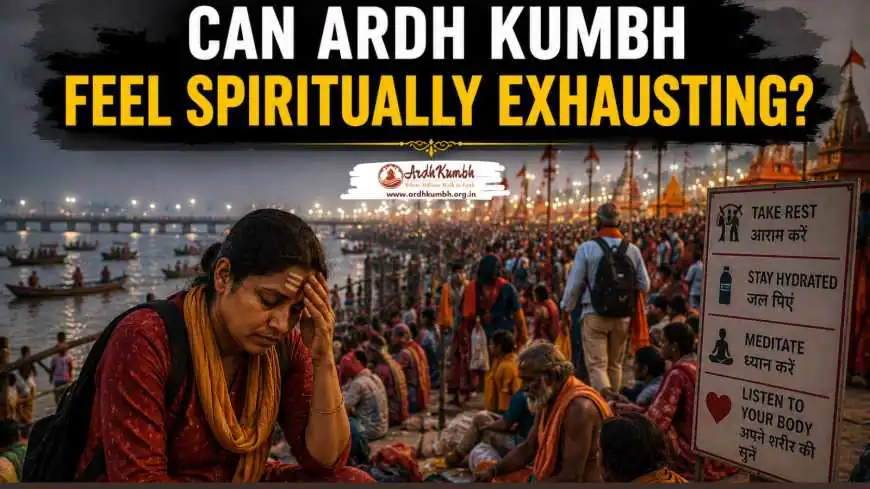
The Overload - When Too Much Sacred Becomes Too Much
Let me start by describing what spiritual exhaustion at Ardh Kumbh actually feels like. Because until you name it, you cannot manage it.
You arrive at Kumbh full of excitement. The first dip is amazing. The first sadhu you meet is inspiring. The first aarti brings tears to your eyes. Everything is sacred. Everything is intense. Everything is meaningful.
Then comes day three. Or day four. Or day five. And suddenly, nothing feels sacred anymore. The chanting that moved you now sounds like noise. The sadhus who seemed holy now look just like tired old men. The Ganga that felt like a goddess now looks like cold, brown water. You feel irritable. You want to be left alone. You want to go home. You feel guilty for feeling this way. "What is wrong with me? Why am I not feeling devotion? Why is this pilgrimage making me feel worse, not better?"
Nothing is wrong with you. You are experiencing spiritual overload. Think of it like eating your favorite food. The first bite is delicious. The tenth bite is still good. The fiftieth bite? You never want to see that food again. Spirituality at Kumbh is like that. The sacred is everywhere. It is constant. It does not stop. And human beings are not designed to stay in peak spiritual states for days on end. You need rest. You need ordinary. You need boring. Kumbh does not give you much of those things. So your spirit gets exhausted. Not because you are doing anything wrong. Because you are human.
Trending Guides Now
Is Ardh Kumbh About Renunciation or Inner Awareness?
Read Guide →
Why Ardh Kumbh Becomes a Turning Point in Life
Read Guide →
Why Ardh Kumbh Feels Like a Spiritual Reset
Read Guide →
Is Ardh Kumbh Truly a Collective Spiritual Practice?
Read Guide →
Best Routes to Reach Haridwar for Ardh Kumbh Mela
Read Guide →
Essential Rules Every Ardh Kumbh 2027 Pilgrim Must Follow
Read Guide →
Who Are Naga Sadhus and Why They Lead Kumbh
Read Guide →
Biggest Crowds Ever Recorded at Ardh Kumbh
Read Guide →This overload is not a sign of weak faith. It is a sign of healthy boundaries. Your psyche is saying, "I need a break." Listen to it. Do not fight it. Do not feel guilty. The pilgrimage is not ruined. You are just in a rough patch. And rough patches are part of every spiritual journey.
The Performance Pressure - Trying Too Hard to Be Spiritual
Let me talk about another cause of spiritual exhaustion at Ardh Kumbh that is entirely self-inflicted. Performance pressure. You come to Kumbh with a script. You are going to meditate every morning. You are going to chant every evening. You are going to take the dip at the most auspicious time. You are going to visit every akhara. You are going to receive blessings from every sadhu. You are going to have profound spiritual experiences every single day.
This script is impossible. You cannot perform your way to spirituality. Spirituality is not a to-do list. It is not a performance. It is not something you can achieve by trying harder.
But try you will. You will wake up early even when you are exhausted. You will stand in line even when your feet hurt. You will chant even when your throat is sore. You will force yourself to feel devotion even when you feel numb. And eventually, you will crash. Because forcing spirituality is like forcing sleep. It does not work. It only makes you more exhausted.
This performance pressure comes from a good place. You want to make the most of your pilgrimage. You want to be a "good" pilgrim. But good pilgrims are not perfect pilgrims. Good pilgrims are honest pilgrims. They admit when they are tired. They rest when they need rest. They skip a dip if their body is screaming. They take a nap instead of going to the aarti.
Let go of the script. Let go of the performance. Let go of the pressure. You do not have to be spiritual every minute. You do not have to feel something every moment. Some of your time at Kumbh will be boring. Some will be frustrating. Some will be exhausting. That is all part of the pilgrimage. The pilgrimage is not just the highs. It is the lows too. And the lows teach you as much as the highs - maybe more.
The Sensory Assault - When Your Nervous System Shuts Down
Let me talk about a physical cause of spiritual exhaustion at Ardh Kumbh that has nothing to do with faith and everything to do with biology. Sensory overload. Your nervous system is designed to process a certain amount of stimulation. At Kumbh, that amount is exceeded by a factor of about a thousand.
Noise. Constant noise. Chanting, bells, shouting, crying, laughing, music, announcements. Your ears never get a break. Sights. Millions of moving bodies, bright colors, flashing lights, smoke, dust. Your eyes never get a break. Smells. Incense, flowers, sweat, food, sewage, river water. Your nose never gets a break. Touch. Crowds pressing against you, cold water, hard ground, hot sun, cold wind. Your skin never gets a break.
After days of this sensory assault, your nervous system does something smart. It shuts down. Not completely. But partially. You feel numb. Detached. Disconnected. Things that should feel sacred feel like nothing. You are not depressed. You are not broken. You are overloaded. And your nervous system is protecting itself by turning down the volume on everything.
This numbness can feel like spiritual exhaustion. You might think, "I have lost my faith. I cannot feel God anymore." But that is not what is happening. Your nerves are just tired. They need rest. They need quiet. They need low stimulation.
The solution is not more chanting. The solution is silence. Find a quiet corner. Sit alone. Close your eyes. Do nothing. Let your nervous system reset. It might take an hour. It might take a day. That is okay. Rest is not a failure of spirituality. Rest is a necessity for spirituality. You cannot pour from an empty cup. And at Kumbh, your cup gets emptied very, very quickly.
The Comparison Trap - Why Someone Else Seems Holier Than You
Let me talk about a psychological cause of spiritual exhaustion that is particularly painful. Comparison. You look around at Kumbh and you see pilgrims who seem so devout. They are chanting with their eyes closed. They are crying tears of devotion. They are taking dip after dip with boundless energy. They are helping strangers with infinite patience.
You look at yourself. You are tired. You are irritable. You are counting the minutes until you can leave. You feel like a fraud. A fake pilgrim. What is wrong with you? Why are they so holy and you are so ordinary?
Here is the truth you need to hear. You do not know what is going on inside those pilgrims. That person crying tears of devotion might be exhausted too. The tears might be from exhaustion, not ecstasy. That person taking dip after dip might be trying to force something they are not feeling. That person helping strangers might be running on adrenaline and will crash later. You see the outside. You do not see the inside.
Comparison is a thief. It steals your peace. It steals your joy. It steals your energy. Because comparing yourself to others is exhausting. You are constantly measuring, judging, coming up short. Stop. Your pilgrimage is yours. Not theirs. Your experience is valid. Not inferior. Your exhaustion is real. Not a failure.
The only person you should compare yourself to at Kumbh is the person you were before you arrived. Are you more patient? More humble? More compassionate? More aware of your own limits? If yes, then the pilgrimage is working. Even if you feel exhausted. Especially if you feel exhausted. Because exhaustion means you have been working. And spiritual work is still work.
The Guilt Spiral - Feeling Bad About Feeling Bad
Let me describe the most exhausting part of spiritual exhaustion at Ardh Kumbh. The guilt spiral. You feel exhausted. Then you feel guilty for feeling exhausted. "I should not feel this way. This is a sacred place. I am so ungrateful. Other people would kill to be here. What is wrong with me?" Then you feel guilty about feeling guilty. The spiral tightens. You feel worse and worse. You use up precious energy beating yourself up. And then you have even less energy for the pilgrimage.
This guilt spiral is pointless and harmful. Feeling exhausted at Kumbh is not a moral failure. It is a human response to extreme conditions. You are not "bad" for feeling tired. You are not "ungrateful" for needing a break. You are not "weak" for wanting to go home.
Let go of the guilt. Seriously. Just drop it. You have permission to be exhausted. You have permission to be irritable. You have permission to be bored. You have permission to miss your bed. These feelings do not make you a bad pilgrim. They make you a human pilgrim. And human pilgrims are the only kind that exist.
When the guilt arises, notice it. Say to yourself, "Ah, there is the guilt. Hello, guilt. I see you. But I do not have to listen to you." Then go back to resting. Or eating. Or sleeping. Or whatever your exhausted self needs to do. The guilt will pass. It always does. Do not feed it with your attention.
The Recovery - How to Heal from Spiritual Exhaustion
Let me give you practical advice on how to recover from spiritual exhaustion at Ardh Kumbh. Because the exhaustion is inevitable. But the recovery is a choice.
Rest. Sleep. Nap. Lie down. Do nothing. Your body and mind need rest more than they need another dip or another blessing. Rest is not laziness. Rest is repair. Skip the early morning aarti and sleep in. You will not lose your spiritual merit. You will gain energy.
Eat. Real food. Simple food. Food that nourishes. Not junk. Your body needs fuel to recover. The bhandaras serve simple, nutritious meals. Eat them. Do not skip meals. Low blood sugar makes everything worse, including spiritual exhaustion.
Hydrate. Drink water. Clean water. Lots of it. Dehydration causes fatigue, irritability, and brain fog. All of which look like spiritual exhaustion but are actually just thirst. Drink before you are thirsty.
Find silence. Get away from the crowds. Even for fifteen minutes. Sit by the Ganga at a quiet spot. Close your eyes. Breathe. Listen to the water. Not the chanting. Not the bells. Just the water. Let the silence wash over you.
Talk to someone. Do not suffer alone. Find a fellow pilgrim who looks as tired as you feel. Say, "I am exhausted. Is that normal?" They will laugh and say, "Yes. Me too." Shared exhaustion is halved exhaustion.
Lower your expectations. You are not going to have a profound spiritual experience every day. Some days, just getting through is enough. Survival is a form of success at Kumbh. Celebrate the small wins. You woke up. You walked to the ghat. You did not cry in public (or maybe you did, and that is fine too). That is enough.
Forgive yourself. For being tired. For being irritable. For not feeling devout. For wanting to go home. Forgiveness is spiritual practice. Practice it on yourself first.
Know when to leave. If the exhaustion is overwhelming, if you are not recovering, if you are becoming depressed or anxious, leave. There is no shame in leaving early. Kumbh will happen again. Your health - mental and physical - is more important than any pilgrimage. Leaving is not failure. Leaving is wisdom.
The Gift of Exhaustion - What Burnout Teaches You
Let me end this section by reframing spiritual exhaustion at Ardh Kumbh. Not as a problem to be solved. As a gift to be received.
What does exhaustion teach you? It teaches you your limits. You cannot do everything. You cannot be everywhere. You cannot please everyone. You cannot feel holy on demand. Knowing your limits is wisdom. Spiritual exhaustion hands you that wisdom on a platter.
Exhaustion teaches you humility. You are not a super-pilgrim. You are a human being with a human body and a human mind. That is okay. That is more than okay. That is truth. Humility is the ground of all spirituality. Exhaustion brings you to that ground quickly.
Exhaustion teaches you compassion. When you are exhausted, you understand why other people are irritable, impatient, and short-tempered. You stop judging them. You start helping them. Compassion born from exhaustion is real compassion. Not the theoretical kind. The lived kind.
Exhaustion teaches you gratitude. After days of discomfort, a simple cup of chai tastes like heaven. A clean toilet feels like a palace. A few hours of uninterrupted sleep is a miracle. Exhaustion burns away your entitlement. What remains is gratitude for the smallest things.
Exhaustion teaches you that spirituality is not about feeling good. It is about showing up. Even when you are tired. Even when you are numb. Even when you want to quit. Showing up is the practice. Feeling good is optional. Exhaustion strips away the optional and leaves the essential. You are here. That is enough.
So yes, Ardh Kumbh can feel spiritually exhausting. Deeply, profoundly, sometimes unbearably exhausting. But that exhaustion is not a sign that you have failed. It is a sign that you have tried. That you have endured. That you have stayed when staying was hard. That is spiritual growth. That is pilgrimage. That is Kumbh.
Frequently Asked Questions