












































































How Entry Gates Are Managed During Ardh Kumbh 2027 Peak Days
Learn how entry gates are managed during Ardh Kumbh 2027 peak days. Discover AI crowd control, holding areas, pass-based entry, parking zones, and safety tips for pilgrims.
The Honest Answer: Yes, Entry Gates Are Managed with Military Precision — Here's How 🚧🛡️
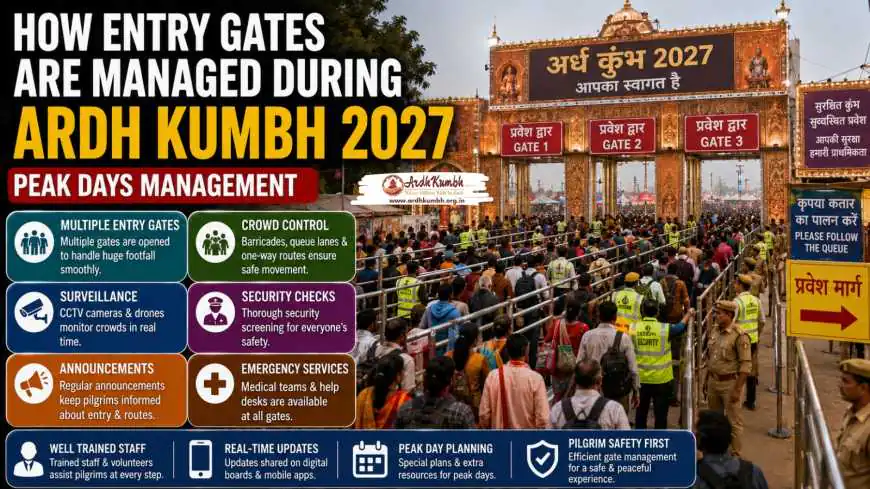
Let's cut straight to what you're really asking. How are entry gates managed during Ardh Kumbh 2027 peak days? The answer is: with a multi-layered, technology-driven system that combines AI-powered crowd monitoring, sector-wise gate management, pass-based access control, and real-time emergency response — all coordinated from a high-tech central command center.
The Ardh Kumbh Mela 2027 in Haridwar (January 14 – April 20, 2027) is expected to draw millions of pilgrims on peak bathing days. On the three Amrit Snan dates — March 6, March 8, and April 14, 2027 — the crowd pressure at entry gates around Har Ki Pauri and other ghats will be unprecedented. The administration has left nothing to chance.
Here's the reality: no private vehicles will be allowed within 6 to 8 kilometers of Har Ki Pauri on these peak days. Access is controlled through pass-based entry systems. Pilgrims park at outer lots and walk or take shuttle services to the fair area. The entire mela area is divided into 11 sectors, each with its own designated entry and exit gates, managed by police, volunteers, and AI-driven monitoring systems.
This guide breaks down exactly how entry gates are managed — from the macro-level traffic planning to the micro-level crowd flow at individual gates. Let's dive in. 🚛🙏
Trending Guides Now
Ardh Kumbh Crowd Management & Facilities Guide
Read Guide →
How Crowd Discipline Is Planned for Ardh Kumbh 2027
Read Guide →
Official Parking Map for Cars, Buses and Bikes at Ardh Kumbh 2027
Read Guide →
How Crowd Flow Will Be Managed in Peak 2027 Days
Read Guide →
Ardh Kumbh 2027 Dates (Official) - Haridwar Snan Schedule
Read Guide →
Dharamshala Stay During Ardh Kumbh: Free & Budget Guide
Read Guide →
Official Progress Report of Haridwar Ardh Kumbh 2027 Infrastructure Projects
Read Guide →
Is October a Good Time to Visit Haridwar Before Ardh Kumbh 2027?
Read Guide →The Big Picture: How the Entire Mela Area Is Organized 🗺️
Before understanding gate management, you need to understand the layout. The Ardh Kumbh 2027 mela area is divided into a hierarchical system of zones, sectors, and gates.
Zones: The Macro-Level Division
The entire Kumbh region is divided into functional zones:
| Zone Type | Purpose |
|---|---|
| Parking & Shuttle Zone | Interfaces between vehicles and walking routes |
| Entry Control Zone | Where gates are located; access is regulated |
| Ghat/Bathing Zone | The sacred area around Har Ki Pauri and other ghats |
| Akhara Zone | Camps of the 13 Akharas |
| Administrative Zone | Control rooms, emergency services, medical camps |
Sectors: The 11 Administrative Units
The mela area is divided into 11 sectors, each with its own:
-
Entry and exit gates
-
Police deployment
-
Lost-and-found center
-
Medical camp
-
Drinking water stations
-
Volunteer team
Gates: The Point of Entry
Each sector has multiple entry gates, ranging from main welcome gates on highways to smaller pedestrian gates near ghats. A "Welcome Gate" is being constructed on the Chhutmalpur-Roorkee Highway near Mandawar Check Post.
Peak Day Protocols: What Changes on Amrit Snan Dates 📅🚨
The three Amrit Snan dates — March 6, March 8, and April 14, 2027 — trigger the highest level of security and gate management protocols.
Zero-Vehicle Zone 🚫🚗
No private vehicles will be allowed within 6 to 8 kilometers of Har Ki Pauri on these dates. This means:
-
You cannot drive to Har Ki Pauri
-
You must park at designated outer parking lots
-
You will be transported via shuttle services to the fair area
Pass-Based Entry 🎫
Access to the main ghat areas is controlled through pass-based entry systems. This means:
-
General pilgrims may need to register or obtain passes
-
Akhara members and VIPs have separate entry protocols
-
Local residents may have special access arrangements
Staggered Access ⏰
General pilgrim access to Har Ki Pauri is restricted or staggered around the Akhara procession window. The Akharas' Shahi Snan (Royal Bath) processions take priority during specific hours.
Human Corridors 👥
By 3 AM on peak days, the ghats are already filling up. Police and Mela volunteers form human corridors to manage the crowd. These corridors guide pilgrims along designated routes to prevent stampedes and ensure smooth flow.
The Technology Behind Gate Management: AI, IoT, and Real-Time Monitoring 🤖📡
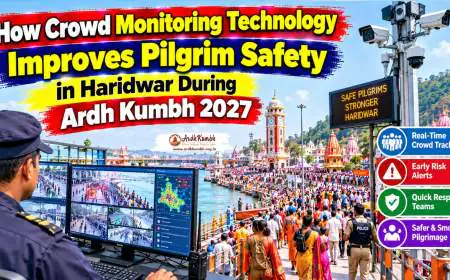
The Ardh Kumbh 2027 is leveraging cutting-edge technology for gate and crowd management.
AI-Based Crowd Management 🧠
Artificial Intelligence is being deployed for crowd monitoring and management. The system can:
-
Detect crowd density at each gate in real-time
-
Predict congestion before it happens
-
Suggest solutions — for example, "Open Gate 3 to release pressure on Gate 7" or "Delay Akhara procession by ten minutes"
-
Alert authorities to potential stampede risks
IoT-Enabled Monitoring 📶
Internet of Things (IoT) sensors are being installed at gates and along key routes. These sensors:
-
Count pilgrims entering and exiting
-
Monitor crowd density
-
Track movement patterns
-
Send real-time data to the central control room
Central Control Room-2 (CCR-2) 🏢
A high-tech central control room-2 (CCR-2) is being built near Har Ki Pauri at an estimated cost of over Rs 50 crore. This facility will:
-
Serve as an integrated command center for security, health services, and traffic management
-
Enable real-time monitoring of the entire mela area
-
Host a helipad on its top floor for emergency helicopter deployment
-
Coordinate all departments — police, health, fire, disaster response
Advanced Traffic Management System (ATMS) 🚦
An Advanced Traffic Management System is being implemented along key routes. This system:
-
Monitors traffic flow in real-time
-
Controls traffic signals dynamically
-
Provides diversion suggestions to reduce congestion
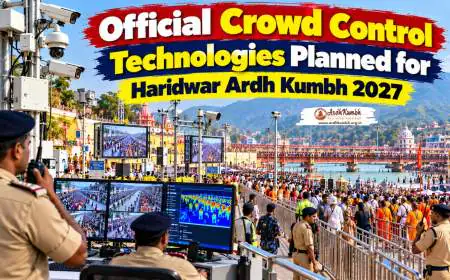
CCTV and Drone Surveillance 🎥🚁
A high-tech CCTV network and drone surveillance are being upgraded for comprehensive monitoring. This allows authorities to:
-
Monitor every gate from the control room
-
Detect unusual activity quickly
-
Guide crowd movement from above
Entry Gate Management: A Step-by-Step Breakdown 🚧👣
Here's what happens at every entry gate during peak days:
Step 1: Arrival at Outer Parking Lots 🅿️
-
Pilgrims arriving by private vehicles are directed to designated outer parking lots
-
These lots are located 6-8 kilometers from Har Ki Pauri
-
Parking is managed by police and volunteers
-
Shuttle services transport pilgrims from parking to entry gates
Step 2: Queue Management at Gates 🚶♂️🚶♀️
-
Barriers and ropes create organized queues
-
Police and volunteers manage the lines
-
Separate queues for men, women, and senior citizens
-
Priority access for persons with disabilities
Step 3: Security Check 🔍
-
Baggage checks at entry gates
-
Metal detectors for security screening
-
CCTV monitoring of all entry points
-
Random checks by police personnel
Step 4: Pass Verification 🎫
-
On peak days, pass-based entry is enforced
-
Pilgrims may need to show registration confirmation or entry passes
-
Akhara members have special passes
-
VIPs have separate entry protocols
Step 5: Crowd Flow Management 🧭
-
Once inside, pilgrims are guided along designated routes
-
Human corridors formed by police and volunteers
-
Crowd-flow markers guide movement
-
One-way routes prevent head-on collisions
Step 6: Emergency Evacuation Routes 🆘
-
Special evacuation routes are planned for emergencies
-
A dedicated evacuation route runs from Dhanush Pul, Astha Path, Anandvan Samadhi, and Chandi Ghat to Bairagi Camp
-
Pilgrims can exit safely within 15-20 minutes through this alternative route
-
This helps crowd control during bathing festivals
Key Entry Gates and Their Locations 🗺️
While the exact number and names of all entry gates are still being finalized, here are the key entry points you need to know:
Major Highway Entry Gates
| Gate Location | Route | Purpose |
|---|---|---|
| Chhutmalpur-Roorkee Highway | Near Mandawar Check Post | Main welcome gate for pilgrims coming from Delhi/UP |
| Najibabad Highway | Gauri parking site | Multi-modal hub under development |
| Haridwar-Rishikesh Highway | Bhupatwala area | Primary entry for pilgrims from Rishikesh/Dehradun |
City Entry Gates
| Gate Location | Access To |
|---|---|
| Har Ki Pauri Main Gate | The most sacred ghat; heavily controlled on peak days |
| Subhash Ghat Gate | Adjacent to Har Ki Pauri; secondary entry point |
| Gau Ghat Gate | Southern portion of Subhash Ghat |
| Bhimgoda Ghat Gate | North of Har Ki Pauri |
| Kushavarta Ghat Gate | Kankhal area, south of main city |
Railway Station Entry Points 🚂
Haridwar Railway Station is a major entry point for devotees. Special arrangements include:
-
Holding area with capacity for 10,000 passengers
-
Additional ticket counters to avoid long queues
-
Organized entry and exit routes
-
Help desks for assistance
-
Special assistance counters for persons with disabilities, senior citizens, and women
Alternative Entry Points 🚉
To reduce congestion at Haridwar, pilgrims may use alternative railway stations:
-
Rishikesh Railway Station (24 km from Haridwar)
-
Dehradun Railway Station (53 km from Haridwar)
The Human Element: Police, Volunteers, and Akharas 👮♂️🤝
Technology alone isn't enough. The human element is equally critical.
Police Deployment 🚔
-
Uttarakhand Police is coordinating with central and state security agencies
-
Local police, NDRF, PAC, Health Department, and Fire Department will handle safety and emergency response
-
Water police, drones, and CCTV cameras are part of the security apparatus
-
Adequate forces will be deployed
-
Government Railway Police (GRP) and Railway Protection Force (RPF) will secure railway stations
Volunteers 🧑🤝🧑
-
Mela volunteers form human corridors to manage crowds
-
They assist with queue management, navigation, and emergency response
-
Language assistance is available for pilgrims from different states
The 13 Akharas 🕉️
All 13 Akharas have assured their participation in the Shahi Snan. Their processions are carefully scheduled to avoid overlapping and crowding at entry gates.
What Pilgrims Need to Know: Practical Tips for Peak Days 📝✅
Before You Arrive
-
☐ Check the peak day dates — March 6, March 8, and April 14, 2027
-
☐ Plan to arrive early — by 3 AM, the ghats are already filling
-
☐ Avoid private vehicles on peak days — use trains or buses
-
☐ Book your travel well in advance — special trains will operate
-
☐ Register for entry passes if required
At the Entry Gate
-
☐ Follow crowd-flow markers
-
☐ Use paid shoe-stands near main entrances
-
☐ Keep your belongings secure — crowds attract pickpockets
-
☐ Listen to police and volunteers — they're there to help
-
☐ Be patient — queues will be long
During Peak Hours
-
☐ Stay hydrated — use official drinking water stations
-
☐ Keep your phone charged — for emergencies
-
☐ Stay with your group — designate a meeting point
-
☐ Avoid rush hours — if possible, visit during non-peak times
-
☐ Know the evacuation routes — in case of emergency
The Infrastructure Behind Gate Management 🏗️
Road Widening and New Bridges 🌉
-
Administrative route from Shankaracharya Chowk to CCR building is being widened
-
Three new bridges are being constructed in the Kumbh Mela area
-
A 90-meter bridge is being built on the SIDCUL-Dhanauri road near Bahadrabad
-
Bridges are designed with crowd control in mind
Parking Infrastructure 🅿️
-
Large parking spaces are being developed at entry points
-
A multi-modal hub is proposed at Gauri parking on the Najibabad Highway
-
Parking and shuttle zones interface between vehicles and walking routes
New Ghats and Pathways 🛕
-
Four new ghats are being built along the Ganga
-
A new ghat from Amarapur Ghat near Dam Kothi to Rishikul Bridge is being developed
-
Pedestrian pathways are being created
Emergency Preparedness: What Happens If Things Go Wrong 🆘
The administration has planned for worst-case scenarios.
Emergency Response Systems
-
CCR-2 serves as the integrated command center for emergencies
-
Helipad on CCR-2 enables quick helicopter deployment during emergencies
-
Emergency evacuation routes are clearly marked
-
Ambulance network with GPS and crowd mapping
-
Disaster response teams are on standby
Communication Systems
-
Public address systems at all gates
-
Real-time updates through mobile apps and social media
-
Help desks at entry points
Learning from the Past: Why 2027 Will Be Different 📖
Previous Kumbh Melas have faced crowd management challenges. The 2021 Kumbh was impacted by COVID-19, with symbolic baths only. The Maha Kumbh 2025 in Prayagraj saw over 4,500 people separated from their families in just 5 hours during the Amrit Snan rush.
For Ardh Kumbh 2027, the administration has:
-
Studied past challenges and strengthened planning
-
Deployed modern technology like AI and IoT
-
Set October 2026 as the deadline for all preparations
-
Requested over Rs 2,000 crore from the central government
-
Emphasized inter-departmental coordination
Final Thoughts: Trust the System, Plan Your Visit 🙏✨
The entry gate management system for Ardh Kumbh 2027 is one of the most sophisticated crowd control operations ever attempted in India. With AI-powered monitoring, 11 sector-wise gates, pass-based access, real-time control rooms, and thousands of police and volunteers, the administration is leaving nothing to chance.
But here's the truth — the system works best when pilgrims cooperate. Arrive early. Follow the rules. Listen to the volunteers. Be patient. And above all, trust the process.
The Ganga awaits you. The Amrit Snan awaits you. The divine energy of millions of devotees awaits you. Plan your entry wisely, and your spiritual journey will be safe, smooth, and unforgettable.
Jai Ganga Maiya! 🙏🌊🕉️
Frequently Asked Questions