





















































How Sadhus Help Maintain Social Stability
Discover how Sadhus serve as living pillars of social stability in India. Learn about their role in conflict resolution, spiritual guidance, and community bonding.
The Silent Glue That Holds Communities Together
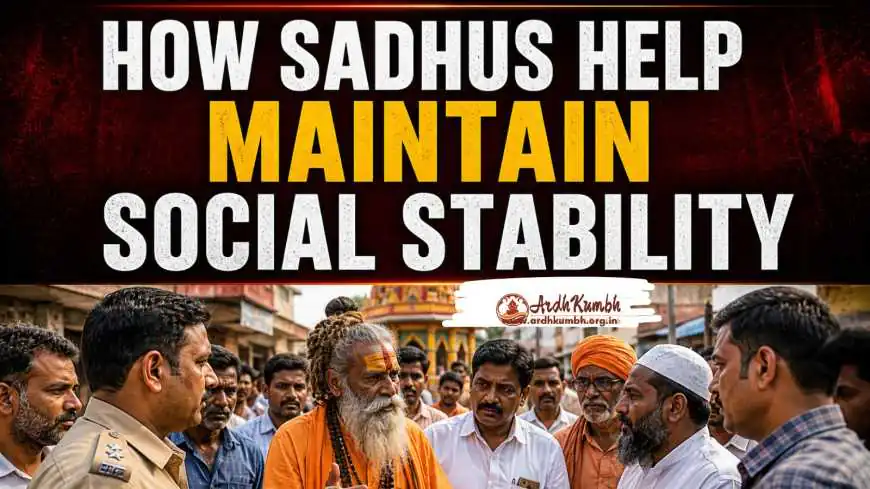
Let me paint you a picture. Imagine a small village in rural India - maybe in Varanasi, maybe in Rishikesh, maybe somewhere deep in the Western Ghats. This village has no proper court. The nearest police station is thirty kilometers away on a bumpy road. Two families are fighting over a boundary wall that has stood for three generations but now everyone disagrees about where the line actually falls. Voices rise. Fists clench. Someone threatens to call a lawyer from the city, which everyone knows means selling a buffalo or taking a loan that will never be repaid.
Then someone says, "Let's go to Baba. He will know what to do."
And just like that, the storm begins to calm.
This happens thousands of times every single day across India. Sadhus occupy a unique social position that no politician, no judge, and no police officer can ever occupy. They are seen as outside the game. They don't want land. They don't want money. They don't want your daughter or your son or your buffalo or your ancestral home. Because they have renounced everything, people trust them with everything.
Trending Guides Now

History of Ardh Kumbh Mela From Samudra Manthan to Modern Times
Read Guide →
How Saints and Sadhus Define the Ardh Kumbh Tradition
Read Guide →
Why Saints Are Called Living Archives of Kumbh
Read Guide →
How Ardh Kumbh Mela Preserved India’s Pilgrimage Routes
Read Guide →
Best Routes to Reach Haridwar for Ardh Kumbh Mela
Read Guide →
Essential Rules Every Ardh Kumbh 2027 Pilgrim Must Follow
Read Guide →
Who Are Naga Sadhus and Why They Lead Kumbh
Read Guide →
Biggest Crowds Ever Recorded at Ardh Kumbh
Read Guide →When a Sadhu speaks, people listen. Not because he can arrest them. Not because he can fine them. But because everyone knows - deep in their bones - that this man has nothing to gain from lying. This is the foundation of how Sadhus help maintain social stability. They become living, breathing arbiters of truth in a world where everyone else seems to be chasing something.
Dispute Resolution Without Courts or Complaints
Let me tell you something fascinating about how this actually works on the ground. Sadhus do not wait for disputes to reach them. They walk. Yes, literally walk. Every day, Sadhus move through villages, towns, marketplaces, and festivals. They sit under peepal trees. They rest on chabutras (raised platforms) near temples. They bathe in public ghats. And because they are everywhere, they hear everything.
When a domestic quarrel threatens to tear a family apart - maybe a son refuses to care for aging parents, maybe a husband drinks too much, maybe a daughter-in-law is treated cruelly - the Sadhu already knows. The neighbors told him. The shopkeeper mentioned it. The village elder pulled him aside and said, "Baba, something must be done."
What happens next is a masterclass in human psychology that no business school could ever teach. The Sadhu does not march into the house like a soldier. He does not shout. He does not threaten. Instead, he simply shows up. He sits outside the house. He asks for a glass of water. He blesses the children. He talks about the weather, the crops, the temple festival next month.
And then, slowly, naturally, the conversation turns to the problem. The Sadhu listens - really listens, not the fake listening where you're already preparing your response. He listens for an hour, sometimes two, sometimes until the sun goes down. And then he says something simple, something ancient, something so obvious that everyone suddenly feels foolish for fighting.
"You are both right. But you are also both wrong. Now eat together. I will stay until you do."
This is not a judge's verdict. This is not a legal settlement. This is relationship repair done by someone who carries no badge, no gun, no ego. And it works. It works because the Sadhu represents something larger than the conflict - he represents dharma, which is not exactly religion but more like cosmic order, the way things are supposed to go when everyone behaves properly.
Breaking the Caste Barrier Without Preaching
Here is something that might surprise you. Many Sadhus come from so-called lower castes. Many come from no caste at all - because once you put on those saffron robes, once you shave your head, once you take sannyasa (renunciation), your old identity is supposed to fall away like a snake shedding its skin. Does this work perfectly? No. Human beings are messy. Prejudice runs deep. But here is the truth: a Sadhu from a Dalit background commands more respect than a Brahmin householder in most spiritual contexts.
Think about what this does for social stability. In a country where caste violence still erupts, where arranged marriages still depend on gotra and sub-caste, where job applications still face discrimination based on surnames - the Sadhu stands as a living contradiction to all of that. When a lower-caste Sadhu sits cross-legged on a higher platform than a upper-caste villager, and that villager touches his feet, something shifts. Not overnight. Not completely. But it shifts.
And here is the even more beautiful part. Sadhus do not lecture about caste equality. They do not hold seminars or write op-eds or start Twitter threads. They simply live differently. They eat from anyone's hands. They sleep in anyone's home. They accept alms from the poorest Dalit woman and the richest Bania merchant with exactly the same expression of gratitude. This lived example seeps into the collective consciousness. Children see it. Teenagers absorb it. Adults, even the prejudiced ones, feel a quiet discomfort when their hatred clashes with the Sadhu's radiant indifference to their status.
That discomfort is the seed of change. And that seed, watered over generations, becomes social stability in its most genuine form - not stability enforced by fear, but stability born from slow, organic transformation of hearts.
The Safety Valve for Economic Pressure
Let me be brutally honest about something uncomfortable. India has poverty that breaks your heart. It has young men who cannot find jobs, young women who cannot find freedom, farmers who cannot find fair prices, and laborers who cannot find dignity. In this pressure cooker of economic despair, violence becomes an option. History shows us that hungry, humiliated people eventually pick up stones, sticks, or worse.
So where do the Sadhus fit into this grim picture? In a way that is both heartbreaking and hopeful.
Sadhus provide a socially acceptable escape valve. When a young man feels completely crushed by his failure to become a "successful" person - to buy a motorcycle, to build a house, to get married, to earn respect - he can walk away. He can shave his head, pick up a kamandal (water pot), and become a Sadhu. No shame attached. In fact, in many communities, families feel honored when a son takes renunciation. They will say, "Our boy has done something holy. He has chosen a higher path."
This is not a solution to poverty. Let me be very clear about that. Poverty needs jobs, education, healthcare, infrastructure, and justice. But until those things arrive - and let's be honest, they will take generations - Sadhus offer a dignified alternative to rage. A man who becomes a Sadhu is not a man who picks up a gun. He is not a man who joins a mob. He is not a man who burns a bus or throws a rock at a shop. He is a man who has chosen stillness over destruction.
And from the perspective of social stability, that is an enormous gift. Every Sadhu wandering the roads of India is a potential revolutionary who chose meditation instead of Molotov cocktails. I am not romanticizing this. It is painful that a young person feels so hopeless that renouncing the world seems like the best option. But within that pain, there is a functional mechanism that has kept Indian society from exploding many, many times over the centuries.
Preserving and Transmitting Cultural DNA
Here is something that Google cannot do and schools cannot teach. The deep, textured, embodied knowledge of rituals, mantras, folk traditions, herbal medicines, astrology, yoga, philosophy, and storytelling - this knowledge lives inside Sadhus. Not in books. Not in databases. In human beings who have spent decades memorizing, practicing, and perfecting these living traditions.
When a village loses its temple priest or its healer or its storyteller, the Sadhu who wanders through every few months fills that gap. He performs the puja that no one else remembers how to do. He chants the mantra that protects the crops from pests. He tells the mythological story that teaches children why honesty matters and why stealing brings ruin. He knows which root cures which fever and which herb brings down which inflammation.
This is cultural continuity. And cultural continuity is the deepest root of social stability. When people feel that their traditions are alive, that their ancestors are not forgotten, that their language and rituals still matter, they feel anchored. An anchored person is far less likely to join a destructive cult, far less likely to burn down a neighbor's shop, far less likely to fall for extremist propaganda that promises to restore a fake, golden past.
The Sadhu is the walking archive of India's spiritual and practical wisdom. And as long as these archives walk the land, society remembers who it is. That memory is stability.
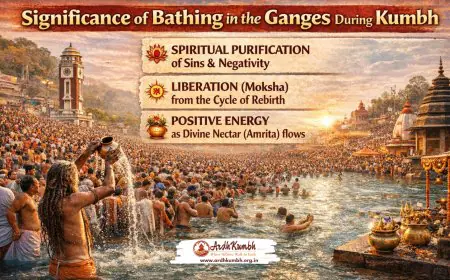
Kumbh Mela - The World's Largest Exercise in Peaceful Coexistence
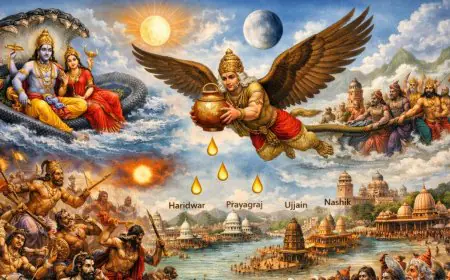
Let me ask you something. How many people can you gather before violence breaks out? Ten thousand? Fifty thousand? A hundred thousand? Now try fifty million. Yes, fifty million human beings gathered in one place - Prayagraj, Haridwar, Ujjain, Nashik - for the Kumbh Mela. That is the population of Spain, plus Canada, plus Australia, all camping together on a riverbank for weeks.
And here is the miracle that the world should study but mostly ignores. Violence is almost nonexistent at the Kumbh Mela. Theft, yes sometimes. Accidents, yes. But communal rioting? Mass brawls? Stampedes caused by hatred? Extremely rare. Almost unheard of considering the scale.
Why? Because Sadhus run the show. Not the government, though the government tries. Not the police, though the police are everywhere. The akhadas (sects of warrior-sadhus) and spiritual leaders create a social order that is older than any modern law. They decide who bathes first and who bathes last. They settle disputes between different akhadas before those disputes turn into fights. They enforce norms of behavior - no loud music during meditation hours, no harassing women, no selling alcohol near holy sites.
When a Sadhu tells a millionaire businessman to wait his turn for a holy dip, that businessman waits. When a Sadhu tells a group of young men to stop pushing and shoving, they stop. The authority is moral, not legal. But it works. It works because everyone at the Kumbh Mela has voluntarily submitted to a higher order - the order represented by the Sadhus.
This is social stability on an incomprehensible scale. And if it can work for fifty million people at a river confluence, it can work for your neighborhood, your workplace, your family.
Mental Health Support Before Mental Health Was a Word
We talk a lot about mental health today. Therapy. Medication. Support groups. Self-care. These are good things. But let me take you to a different world. A poor farmer in Bundelkhand whose crops have failed for three straight years. His debt is crushing him. His wife cries at night when she thinks he is asleep. He has no money for a therapist. He has never heard the words "depression" or "anxiety."
What does he do? He walks to the nearest Sadhu. Not because he understands psychology. Because he understands darshan - the simple act of sitting in the presence of a holy person, looking at them, receiving their gaze, feeling somehow lighter afterward.
Does the Sadhu give him medication? No. Does he give him a diagnosis? No. But he gives him something that modern psychiatry is finally rediscovering as essential - unconditional positive regard, compassionate listening, and meaning.
The Sadhu might say, "You are suffering because you are holding onto something that was never yours. Your land belongs to the earth. Your body belongs to death. Your worries belong to the wind. Why are you holding the wind?"
This sounds like poetry. But for a man suffocating under debt, this reframing cuts through despair like a knife through butter. He realizes that his identity as a "failed farmer" is just a story. He can tell a different story. He can become a pilgrim, a devotee, a seeker. And those identities come with dignity, not shame.
Sadhus have been doing community mental health support for thousands of years without calling it that. And in a country with one psychiatrist for every 100,000 people, this informal, free, always-available support system is a pillar of social stability that no government could ever replace.
Guardians Against Exploitation and Corruption
Let me tell you something that might make you uncomfortable. Many Sadhus are poor. Dirt poor. Sleep-on-the-ground, eat-what-you-get, own-nothing poor. And because they own nothing, they cannot be bribed. Because they cannot be bribed, they are dangerous to corrupt people.
When a government official tries to extort money from a village for a road that was already paid for by taxes, who speaks up? The Sadhu. When a landlord tries to evict a widow from the home her husband built, who sits at her doorstep and refuses to move? The Sadhu. When a police officer demands a bribe to file an FIR for a stolen buffalo, who threatens to sit on a dharna (protest fast) outside the station? You guessed it - the Sadhu.
The Sadhu has no political power. But he has moral power, which in India often matters more. A corrupt official can ignore a lawyer's notice. He can laugh at a politician's criticism. But when a barefoot Sadhu sits outside his office and refuses to eat until justice is done, the official sweats. Because he knows that the media will come. He knows that the higher authorities will notice. He knows that the village will unite behind the Sadhu.
This anti-corruption function is massive for social stability. Nothing destabilizes society faster than widespread, unpunished corruption. When people believe the system is rigged, when they believe that the rich and powerful can do anything and the poor can do nothing, rage builds. That rage eventually explodes. Sadhus, by standing against corruption without asking for anything in return, drain that rage before it reaches the bursting point.
Creating Sacred Space in a Chaotic World
Let me end this section with a quiet observation. Indian cities are loud. They are crowded. They are stressful. Millions of people wake up every morning in tiny rooms, travel on packed buses, work long hours in noisy factories or stressful offices, and come home to more noise, more demands, more pressure.
Where do they find peace? Where do they find silence? Where do they find a moment to breathe?
The temple where a Sadhu sits is that space. Not the grand, wealthy temples with ticket booths and security checks - though those are fine. The small, quiet, slightly crumbling temple where an old Sadhu sits with closed eyes, ignoring the world, radiating stillness. Anyone can walk in. Anyone can sit down. Anyone can close their eyes and, just for a few minutes, exist without demands.
This is not a small thing. This is public mental health infrastructure. This is free therapy. This is community meditation before meditation became a billion-dollar industry. And it holds society together by giving tired, overwhelmed people a place to recharge their humanity.
Without these spaces, without these living saints who maintain them simply by being there, the pressures of modern life would become unbearable for many. And unbearable people do unstable things.
The Thread That Weaves Past, Present, and Future
Here is what I want you to take away from this entire article. Sadhus are not relics of a bygone era. They are not tourist attractions for spiritual seekers from California. They are not just holy men who smoke weed and tell jokes (though some do, and that is its own kind of social service).
Sadhus are functional, essential, irreplaceable pillars of Indian social stability. They do what laws cannot do - they touch hearts. They do what police cannot do - they prevent conflicts before conflicts begin. They do what politicians cannot do - they speak truth without wanting votes. They do what families cannot do - they see everyone as their own.
You do not have to believe in God to see the value of this. You do not have to become a Sadhu yourself. But if you want to understand why India, with all its chaos and contradictions, has not collapsed into civil war - look at the saffron robes walking the dusty roads. Look at the ashrams tucked into every corner of every city. Look at the matted hair and the rudraksha beads and the patient, enduring eyes of people who have given up everything except the one thing that matters - the quiet work of holding the world together.
That is how Sadhus help maintain social stability. Not with force. Not with laws. With presence. With example. With love that expects nothing back. And in a world that is constantly pulling apart, that kind of love is the only thing that truly holds us together.
Frequently Asked Questions