













































































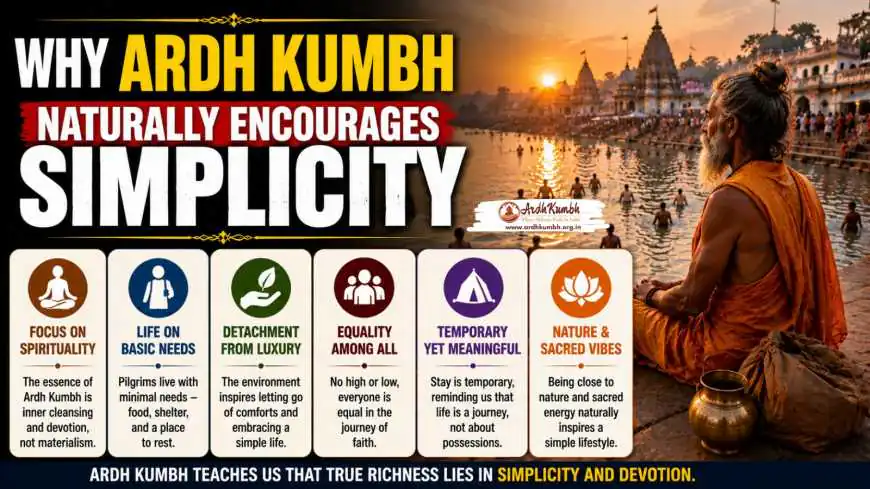
Why Ardh Kumbh Naturally Encourages Simplicity
Discover how Ardh Kumbh strips away life's clutter. From basic living to shared meals, learn why this sacred pilgrimage naturally leads pilgrims to simplicity.
You Cannot Bring Your Whole House to a Tent
Let me start with the most literal truth. The Ardh Kumbh is a temporary city. You will sleep in a tent, a dormitory, or on an open floor. You will not have a wardrobe. You will not have a closet. You will not have drawers. You will have a small bag — maybe two — and a corner of a room. That is all. That physical constraint alone forces simplicity. You cannot bring ten pairs of shoes because there is no space to store them. You cannot bring five different jackets because you have nowhere to hang them. You cannot bring your favorite pillow because it will take up half your bag. The tent becomes a teacher. It whispers, "Choose carefully. Bring only what you truly need." And for the first time in years, you actually listen. You pack one pair of comfortable shoes instead of four. You pack two sets of clothes instead of twelve. You leave the hairdryer at home. You leave the laptop at home. You leave the "just in case" items at home. And when you arrive, you discover that you have everything you need. Nothing more. Nothing less. That feeling — of having enough — is the first gift of Kumbh simplicity.
The Queue Has No Patience for Luxury
Let me talk about the queue. The great equalizer. You can be a millionaire in your regular life. You can fly first class. You can stay in five-star hotels. You can wear designer clothes. But in the Kumbh queue, none of that matters. The queue does not care about your net worth. The queue does not part for your credit card. The queue does not have a VIP lane for people who are used to getting what they want. In the queue, you are just another body — standing, shuffling, waiting. And in that standing, something shifts. You stop caring about your status. You stop caring about your appearance. You stop caring about the things that usually consume your thoughts. You care only about moving forward. About keeping your balance. About helping the elderly person next to you. About not losing your temper. The queue strips away pretension like a flame stripping away varnish. What remains is something raw and real — a person, not a persona. That is simplicity at its deepest level. Not just having fewer things. But being less pretentious. Less performative. More human.
The Ganga Does Not Recognize Brands
Here is a liberating truth. When you stand in the Ganga for your snan, the water does not check your labels. The Ganga does not know the difference between a silk saree and a cotton one. The Ganga does not care if your rudraksha beads cost ten rupees or ten thousand. The Ganga simply flows. And as you immerse yourself, you realize something profound. All that branding was in your head. The Ganga washes away not just your sins, but your illusions about what matters. You see the millionaire next to you, also wet, also shivering, also clutching a small cloth bag with his valuables. He looks just like you. He feels just like you. In that water, the artificial distinctions that consume your daily life — the car you drive, the watch you wear, the phone you carry — become laughably irrelevant. The Kumbh does not tell you that simplicity is good. It shows you that complexity was unnecessary all along. The Ganga is the great unveiler. She reveals the simplicity that was always there, buried under layers of wanting and owning and showing off.
Langar: The Meal Where Everyone Is Equal
Let me take you to the langar. The community kitchen. Here, simplicity is not just encouraged — it is the entire point. You sit on the floor. Not on a chair. On the floor. Next to strangers. Across from a family you will never meet again. There is no table. No menu. No waiter. No wine list. There is dal. There is roti. There is rice. Sometimes kheer if you are lucky. That is it. And here is the miracle. It tastes better than any restaurant meal you have ever had. Why? Because you are hungry. Because you are tired. Because you earned it by walking for hours. Because you are surrounded by people who are eating the same simple food with the same simple gratitude. The langar teaches simplicity in the most direct way possible. It shows you that food is not entertainment. Food is not status. Food is not a hobby. Food is sustenance. And when you eat with that understanding — without scrolling through your phone, without complaining about the options, without analyzing the ingredients — the meal becomes sacred. That is the simplicity of the langar. It is not fancy. It is not complicated. It is just enough. And somehow, that is everything.
Trending Guides Now

Can Ardh Kumbh Change Your Life Priorities?
Read Guide →
What Makes Ardh Kumbh Spiritually So Powerful?
Read Guide →
What Ardh Kumbh Symbolizes in Sanatan Dharma
Read Guide →
Can Ardh Kumbh Shape Your Daily Discipline? A Journey That Lasts Longer Than the Dip
Read Guide →
Ardh Kumbh 2027 Dates (Official) - Haridwar Snan Schedule
Read Guide →
Dharamshala Stay During Ardh Kumbh: Free & Budget Guide
Read Guide →
Official Progress Report of Haridwar Ardh Kumbh 2027 Infrastructure Projects
Read Guide →
Is October a Good Time to Visit Haridwar Before Ardh Kumbh 2027?
Read Guide →You Cannot Scroll and Walk at the Same Time
Here is a modern problem that the Kumbh solves effortlessly. Your phone addiction. At home, you check notifications every few minutes. You scroll through Instagram while eating. You answer emails while watching TV. Your attention is fractured into a thousand pieces. At the Kumbh, you cannot do that. You are walking. Constantly. From your tent to the ghat. From the ghat to the langar. From the langar to the akhara camp. You are navigating crowds, avoiding obstacles, watching your step. There is no space for distracted scrolling. If you look at your phone while walking, you will trip. You will bump into someone. You will lose your group. The Kumbh forces you to be present. To look up. To see the world with your eyes, not through a screen. And when you do, you notice things. The color of the sunset on the Ganga. The smile of a child. The kindness of a stranger helping an elderly pilgrim. The sound of a bhajan floating from somewhere nearby. These things were always there. You just never saw them because you were looking down. The Kumbh does not ban phones. It simply makes presence more practical than distraction. That is simplicity of attention. And it is life-changing.
The Uniform of the Pilgrim: Cotton and Comfort
Look around the Kumbh. What are people wearing? Cotton. Simple. Comfortable. Salwar kameez for women. Kurta pyjama or simple pants for men. Saffron for the sadhus. That is it. You will not see designer logos. You will not see expensive watches. You will not see flashy jewelry. Why? Because none of that survives the Kumbh. Jewelry gets lost or stolen. Expensive clothes get torn or stained. Logos mean nothing in a crowd of millions. The Kumbh creates a uniform — not by law, but by practicality. And this uniform is a great simplifier. When everyone looks more or less the same, you stop judging people by their clothes. You stop presenting a curated version of yourself. You just are. That freedom — from the pressure to dress a certain way, to signal a certain status — is immense. It is the freedom of anonymity. The freedom of not performing. The Kumbh gives you permission to dress for function, not for fashion. And once you experience that permission, you start wondering why you ever cared about the other thing.
The Absence of Choice Is Actually Liberating
Modern life is obsessed with choice. What to eat? What to wear? What to watch? What to buy? Which route to take? Which brand to trust? This endless choice is not freedom. It is exhaustion. The Kumbh simplifies ruthlessly. You eat what is served at the langar — no menu, no substitutions. You wear what you brought — no wardrobe changes, no outfit planning. You go where the crowd goes — no GPS, no deliberation. You sleep when you are tired — no bedtime procrastination. The absence of choice is not restrictive. It is liberating. Your brain, freed from the tyranny of decisions, can finally rest. You stop asking "What if?" and start accepting "What is." That acceptance is the heart of simplicity. Not because you have fewer options, but because you have stopped needing options. The Kumbh teaches you that most of your daily "choices" are not choices at all. They are anxieties dressed up as preferences. When you let them go, you do not lose anything. You gain peace.
The Sadhu as the Ultimate Minimalist
Let me point to the extreme. The Naga Sadhu. He owns nothing. A begging bowl. A trident. The cloth on his body — and sometimes not even that. His ash-smeared skin is his only protection from the cold. He sleeps where he falls. He eats what he is given. He has no bank account. No phone. No address. No family. No possessions. By any measure, he is the ultimate minimalist. And yet — watch him. Is he miserable? Is he deprived? Is he secretly longing for a comfortable bed and a hot shower? No. He is radiant. He moves through the Kumbh with a freedom that the richest CEO will never know. The sadhu is the living proof of what simplicity can achieve. Not poverty. Not deprivation. Liberation. He is not simple because he has nothing. He is simple because he wants nothing. That is the distinction that changes everything. The Kumbh does not expect you to become a sadhu. But it shows you one. It places him in your path. It asks you to consider — if he can be happy with nothing, why am I not happy with everything I have? That question is the beginning of simplicity. Not as a lifestyle choice. As a spiritual realization.
Taking Simplicity Home: The Kumbh Effect
Here is the most important thing I can tell you. The simplicity of the Kumbh does not have to end when you leave. Many pilgrims report that the Kumbh changed their relationship with stuff. They come home and look at their closets differently. Do I really need seventeen shirts? They look at their kitchen differently. Do I really need all these appliances? They look at their schedule differently. Do I really need to attend every event, buy every new thing, keep up with every trend? The Kumbh plants a seed. It shows you that you survived — no, thrived — with very little. It shows you that happiness is not correlated with consumption. It shows you that peace comes from presence, not from possessions. You do not have to sell everything and move into a cave. But you might find yourself donating the clothes you never wear. Decluttering the rooms you never use. Saying no to invitations that drain you. Eating simpler meals. Spending less time on your phone. These are the fruits of the Kumbh's lesson in simplicity. They ripen slowly, over months and years. But they are real. And they change lives.
The Empty Hands That Receive the Most
Let me end with an image. A pilgrim stands at the edge of the Ganga. His hands are empty. He has no phone taking a video. No friend recording his moment. No camera capturing the sunrise. No bag of offerings. No list of rituals to perform. Just empty hands. And then he cups them. Fills them with Ganga water. Lifts them to the sun. Lets the water fall back into the river. That is all. That is everything. The Kumbh teaches that simplicity is not about having less. It is about being more present with what you have. Empty hands can receive. Empty hands can give. Empty hands can pray. The Kumbh strips away the clutter so that you can stand at the river with nothing but your faith and your gratitude. And in that standing, you discover that you never needed anything else. The Ganga does not ask for your offerings. She asks for your presence. And presence — the willingness to be here, now, with nothing between you and the sacred — is the simplest, hardest, most beautiful thing in the world. The Ardh Kumbh gives you that gift. Not by teaching you about simplicity. By giving you no choice but to live it.
Frequently Asked Questions