



































































Is Ardh Kumbh About Faith or Daily Practice?
Is Ardh Kumbh about faith or daily practice? A honest, heartfelt exploration of belief vs. action, surrender vs. discipline, and the living heart of pilgrimage.
Is Ardh Kumbh About Faith or Daily Practice?
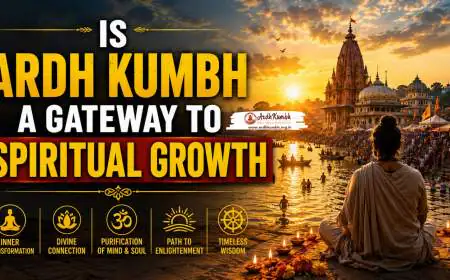
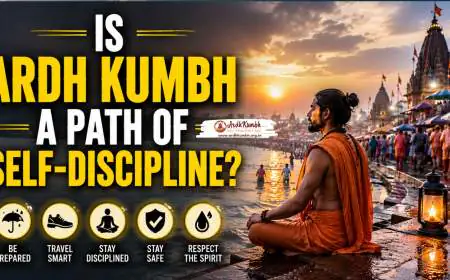
Let me start with a story that will tell you everything. At the last Ardh Kumbh, I met a young man — maybe twenty-five years old — who had walked from his village in Uttar Pradesh. No shoes. No bag. Just a rudraksha mala around his neck and a lotus in his hand for offering. He had walked for eighteen days. I asked him: "Why did you walk? Why not take the train?" He looked at me like I had asked why the sun rises. "Because I promised Maa Ganga," he said. "Every morning for two years, I woke up at 4 AM and walked one hour. That was my sadhana. This walk is just the final step." That young man had faith — deep, unshakeable, irrational faith. But his faith had been fed by daily practice. Two years of morning walks. Two years of promises kept. Two years of showing up, even when he did not feel like it. By the time he reached the Ganges, his faith was not a belief in his head. It was a muscle in his legs. That is the Ardh Kumbh. Not a choice between faith and practice. A marriage. And like any good marriage, it takes work every single day.
Faith – The Unseen Engine
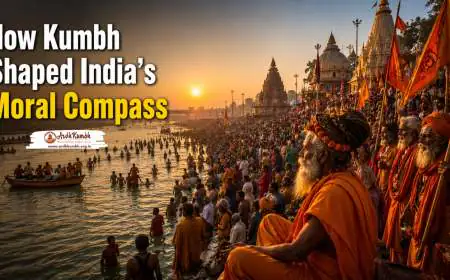
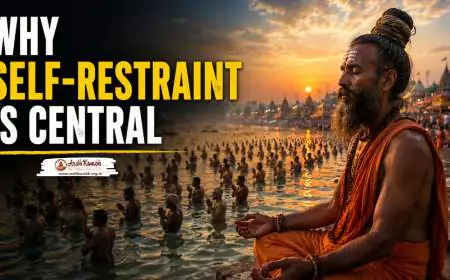
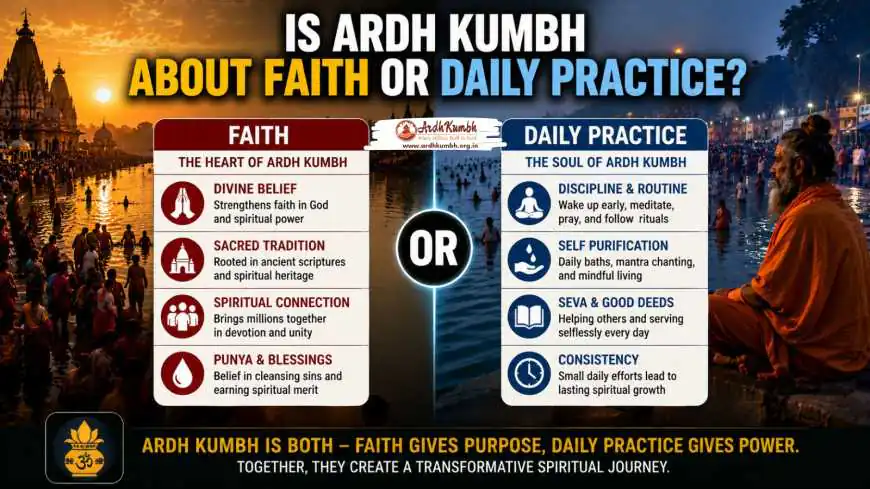
Let me talk about faith first, because it is the more glamorous one. Faith is what you see in the eyes of the grandmother who has saved her entire life for this dip. Faith is what makes the Naga Sadhu sit naked in the snow, meditating on a mantra that he has never seen written down. Faith is what brings crores of people to the same river at the same time, year after year, century after century. Faith is the engine. It is the why. Why endure the cold? Why tolerate the crowd? Why spend the money? Why leave your comfortable home? Because you believe. You believe the Ganges can wash away your sins. You believe the stars align for your liberation. You believe that God is real, and that God is waiting for you in that water. Without that faith, the Kumbh is just a crowded, dirty, overrated festival. The faith is what makes it sacred. The faith is what makes it Kumbh.
Daily Practice – The Visible Body
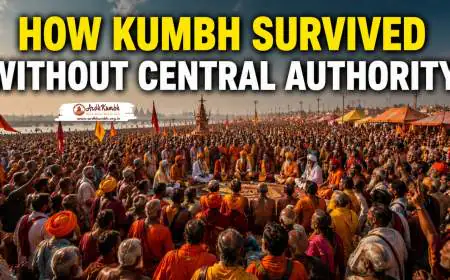
But here is the thing about faith. Faith alone is invisible. You cannot see it. You cannot measure it. You cannot prove it. The only way faith becomes real in the world is through daily practice. The grandmother's faith is real because she saved a handful of rupees every week for six years. That is practice. The Naga Sadhu's faith is real because he meditates for eight hours every day. That is practice. The crores of pilgrims have faith because they woke up early, walked the distance, stood in the cold, dipped in the water, chanted the mantras, served at the Bhandara. That is practice. Daily practice is the body of faith. Without a body, faith is a ghost — haunting, perhaps, but unable to act. The Ardh Kumbh is where faith grows a body. Millions of bodies. Moving, chanting, dipping, serving. That is practice at the scale of a small country. And that practice is what makes the faith visible — to others, and to yourself.
The Danger of Faith Without Practice
Let me be blunt about something that nobody likes to admit. Faith without practice is lazy. It is the person who says "I believe in God" but never prays. It is the person who says "the river will cleanse me" but never walks to the river. It is the person who says "I am spiritual" but never meditates, never fasts, never serves, never sacrifices. That kind of faith is cheap. It costs nothing. And because it costs nothing, it is worth nothing. The Ardh Kumbh has no patience for cheap faith. The cold will expose you. The crowd will test you. The exhaustion will break you. If your faith is only in your head, you will quit by the second day. You will complain about the mud, the cold, the crowd, the food. You will go home and tell everyone the Kumbh is overrated. But if your faith has been trained by daily practice — if you have been waking early, walking daily, practicing patience, serving others — then the Kumbh will feel like home. Because you have been practicing for it every day for years. The Kumbh is not the beginning of your spiritual journey. It is the exam after years of daily homework. And the exam rewards those who did the homework.
Trending Guides Now

What Makes Ardh Kumbh Spiritually So Powerful?
Read Guide →
What Ardh Kumbh Symbolizes in Sanatan Dharma
Read Guide →
Can Ardh Kumbh Shape Your Daily Discipline? A Journey That Lasts Longer Than the Dip
Read Guide →
Is Ardh Kumbh a Gateway to Spiritual Life? Or Just a Dip in Cold Water?
Read Guide →
Dharamshala Stay During Ardh Kumbh: Free & Budget Guide
Read Guide →
Best Routes to Reach Haridwar for Ardh Kumbh Mela
Read Guide →
Haridwar Weather by Month: Best Time to Plan Your Visit
Read Guide →
Complete Haridwar Packing Checklist for Every Season
Read Guide →The Danger of Practice Without Faith
Now let me talk about the other side. Practice without faith is a workout. It is good for you. It builds discipline. It creates routine. It might even improve your health. But it is not spiritual. It is mechanical. You can wake up at 4 AM every day and take a cold shower. You can chant mantras from a book without understanding them. You can walk ten kilometers daily. You can serve at a food kitchen. All of that is practice. But without faith, it is just movement. The Ardh Kumbh is full of people who come for the "experience" — the photos, the stories, the bucket list checkmark. They do the practices. They take the dip. They watch the aarti. But they feel nothing. Why? Because they came with their bodies but left their hearts at home. They did the practice without the faith. And the river knows the difference. The river does not judge. But the river does not give grace to a closed heart. Practice without faith is a body without a soul. It moves. But it does not live.
The Marriage – How Faith and Practice Feed Each Other
Here is the beautiful secret that the Ardh Kumbh teaches. Faith and practice are not two things. They are two halves of a single breathing cycle. Faith is the inhale — the receiving, the believing, the surrendering. Practice is the exhale — the acting, the doing, the manifesting. You cannot inhale forever. You will explode. You cannot exhale forever. You will collapse. You need both. The Kumbh is where you learn to breathe spiritually. Your faith brings you to the river. Your practice makes you walk into the water. Your faith makes you believe the dip will cleanse you. Your practice makes you duck your head under. Your faith gives you the courage to let go. Your practice gives you the discipline to stay in the cold water for thirty seconds instead of five. They feed each other. Your practice strengthens your faith. Your faith deepens your practice. By the time you leave the Kumbh, you cannot tell where one ends and the other begins. That is the goal. That is the marriage.
What the Saints Say – Practice Is Faith Made Visible
Let me tell you what a saint told me at the last Kumbh. I asked him: "Guruji, what is more important — faith or practice?" He smiled and said nothing for a long time. Then he picked up a piece of coal from the fire and drew a circle on the ground. "This is faith," he said. Then he drew a second circle, overlapping the first. "This is practice. Where they overlap, that is truth. If you have only faith, you have a circle that touches nothing. If you have only practice, you have a circle that touches nothing. But when they overlap, you have solid ground to stand on. That solid ground is the Kumbh. That solid ground is you." Then he threw the coal back into the fire and walked away. I stood there for a long time, staring at two overlapping circles on the dusty ground. I understood then. The Kumbh is not asking you to choose. It is asking you to overlap. Bring your faith. Bring your practice. Let them touch. Let them merge. And then stand on that solid ground. That is the whole pilgrimage.
The Daily Practice That Leads to the Kumbh
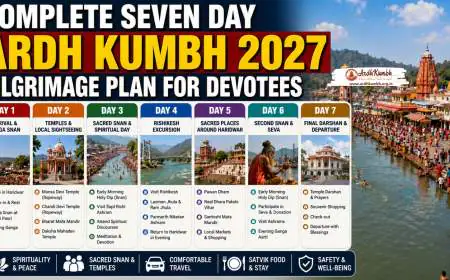
Let me give you a practical takeaway. If you are planning to attend the Ardh Kumbh 2027, do not wait until January to start your practice. Start now. Wake up earlier. Walk daily. Practice patience in small situations. Serve someone without expecting thanks. Chant a mantra for five minutes every morning. Fast from something you love one day a week. These small daily practices are not separate from the Kumbh. They are the path to the Kumbh. They are the training for the exam. When you finally stand in that freezing water, your body will remember the early mornings. Your mind will remember the patience. Your heart will remember the service. And the dip will not feel like a one-time event. It will feel like the culmination of years of small, faithful actions. That is the Kumbh — not a break from your daily practice, but its completion.
The Faith That Survives the Kumbh
And here is the final gift. The faith that you bring to the Kumbh — if it is real, if it is deep, if it is fed by daily practice — will survive the Kumbh. Most people have a spiritual high at the Mela and then crash when they go home. The cold water fades. The aarti becomes a memory. The crowd becomes a story. But if your faith is built on daily practice, the Kumbh does not end when you leave. It continues. Because you continue your practice. You still wake up early. You still walk. You still chant. You still serve. The Kumbh becomes not a memory, but a rhythm. A rhythm that you carry in your body, your breath, your bones. That is the faith that matters. Not the faith that bursts into flame at the river and then dies. But the faith that burns slowly, steadily, every single day, like a lamp fed by a steady stream of oil. That oil is daily practice. The flame is faith. The Ardh Kumbh is where you see that flame reflected in a million lamps, all burning together, all fed by the same oil. And you realize: you were never alone. You were always part of this. You just forgot. The Kumbh reminds you.
The River's Question to You
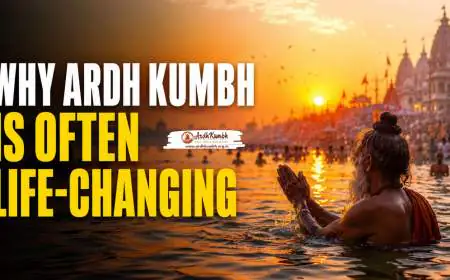
So let me leave you with this. The Ganges does not ask you: "Do you have faith?" The Ganges does not ask you: "Do you have practice?" The Ganges asks you one question: "Are you here?" Not just your body. Not just your beliefs. You. Your whole self — the believing part and the doing part, the dreaming part and the waking part, the faithful part and the practicing part. Are you here? If you are, the river will do the rest. It will take your faith and your practice and blend them into something new. Something that is not quite faith and not quite practice. Something that is you — but a deeper you. A truer you. A you that has stood in the cold water of the Ganges and felt the weight of a million prayers and decided to keep living, keep practicing, keep believing. That is the Ardh Kumbh. Not a choice between faith and practice. A yes to both. A yes to the river. A yes to yourself. Now go say yes.
Frequently Asked Questions