
























































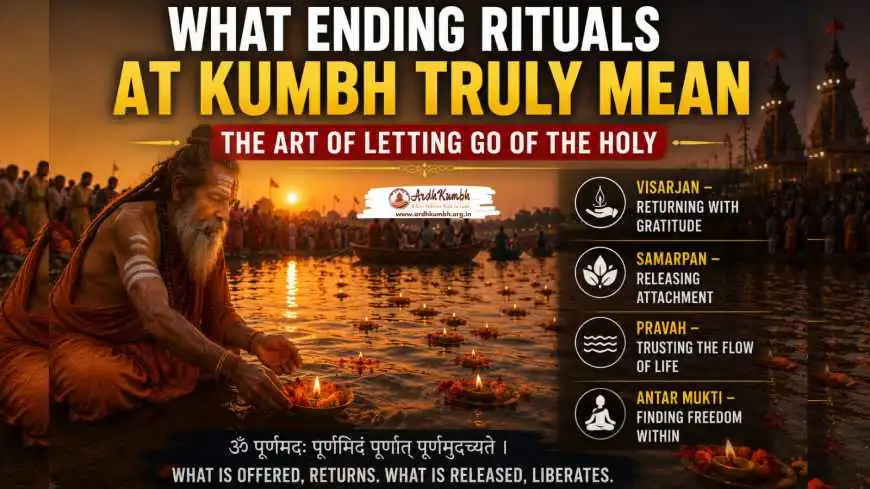
What Ending Rituals at Kumbh Truly Mean – The Art of Letting Go of the Holy
What ending rituals at Kumbh truly mean. Not just goodbye. They teach detachment, gratitude, and the courage to return to ordinary life. Sacred secrets inside.
Why Ending Rituals Matter More Than Beginning Ones
We love beginnings. The first dip. The first sight of the Sangam. The first chai in a new tent. Beginnings are full of hope, adrenaline, and possibility.
Endings are harder. Endings ask us to release. To accept that something beautiful is over. To trust that we can carry its essence without its form.
At Kumbh, the ending rituals are deliberate. They are not an afterthought. They are designed – over centuries – to help the pilgrim transition from sacred time back to ordinary time. From holy ground back to kitchen floor. From we back to I.
If you skip the ending rituals, you leave Kumbh with a hangover – a longing, an incompleteness, a sense that something was left undone. If you perform them – even without understanding – you leave with closure. And closure is not about forgetting. It is about integrating.
Trending Guides Now

Har Ki Pauri Ganga Aarti Time Today in Haridwar
Read Guide →
Complete Guide to Ardh Kumbh Rituals
Read Guide →
Ardh Kumbh Mela Rituals Explained Shahi Snan & Akhara Traditions
Read Guide →
Why Order and Cleanliness Are Strictly Enforced
Read Guide →
Best Routes to Reach Haridwar for Ardh Kumbh Mela
Read Guide →
Ardh Kumbh 2027 Dates (Official) - Haridwar Snan Schedule
Read Guide →
How Kumbh Keeps India’s Civilizational Memory Alive
Read Guide →
February Weather Reality at Ardh Kumbh
Read Guide →The Six Ending Rituals at Kumbh (And What Each One Truly Means)
1. The Final Dip – Not for Sin, For Surrender
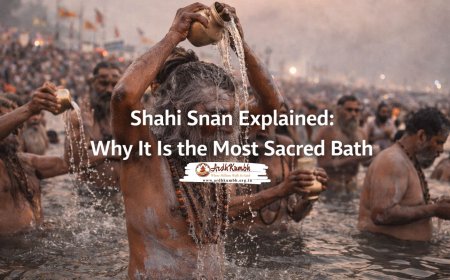
Most people think every dip at Kumbh is for washing sins. The final dip is different. It is not about cleansing. It is about surrendering.
You stand at the ghat on the last morning. The water is the same cold. The sky is the same grey. But something in you has changed. You are not the same person who stepped in on day one.
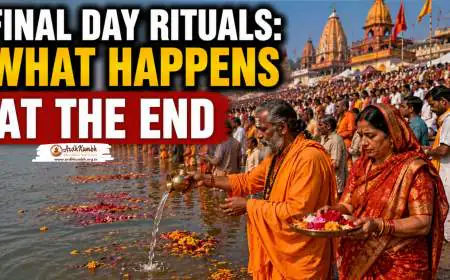
As you dip your head for the last time, you are not asking the Ganga to take your sins away. You are asking her to take your attachment to this experience. You are saying: I am grateful. I am full. I am ready to go. You are not leaving the river. You are taking her inside you – and asking her to release your grip on the outer form of the fair.
What it truly means: The final dip is a divorce from the place but a marriage to the memory. It is the moment you stop being a pilgrim and start being a witness to your own pilgrimage.
2. The Packing of the Tent – Sacred Geometry of Letting Go
Watch a family pack their tent on the last day. It is not like packing a suitcase at home. There is silence. There is slowness. There is care. The blanket that kept them warm for twelve nights is folded precisely. The steel glass that held chai every morning is wiped clean and wrapped in a cloth. The mud from the tent floor is swept – not out of duty, but out of respect.
This is not cleaning. This is ritual.
What it truly means: Packing the tent teaches you that impermanence is not a tragedy. It is a rhythm. You cannot live in the tent forever. But you can fold it with care, carry it with gratitude, and trust that you will pitch it again – maybe at the next Kumbh, maybe somewhere else. The act of packing is a meditation on non-attachment.
3. The Langar's Last Meal – Communion Before Scattering
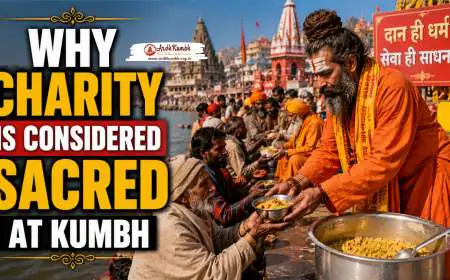
On the last day of Ardh Kumbh, the langars serve their final meal. The same dal, the same roti, the same chawal. But everyone eats slowly. Everyone makes eye contact with strangers. Everyone lingers over the empty plate.
No one announces “this is the last meal.” But everyone knows.
What it truly means: The last langar is a reminder that community is temporary – and that is exactly what makes it precious. You will never sit next to this farmer from Bihar again. You will never share a steel plate with this widow from Varanasi again. The final meal forces you to see the person next to you – not as a stranger, but as a fellow traveler you will never meet again. That seeing is the ritual.
4. The Lowering of the Flags – Sacred Symbols Return to the Earth
At many camps and akharas, the last ritual is the lowering of the saffron flag or the camp banner. It is done slowly, often with a prayer or a bell. The flag that flew day and night for weeks is folded, touched to the forehead, and stored until the next Kumbh.
What it truly means: The flag is not just cloth. It is a promise – that the community will return, that the tradition will continue, that the energy is not destroyed, only stored. Lowering the flag is a ritual of continuity. It says: this is not goodbye. It is 'see you later'.
5. The Cleaning of the Ghat – Scrubbing Away the Sacred to Make Room for the Next
After the final dip, local volunteers and sevadars clean the bathing ghats. They scrub the stones, sweep the steps, collect the flowers and prasad left behind. To an outsider, this looks like maintenance. To a pilgrim, it is ritual.
What it truly means: Cleaning the ghat is an acknowledgment that the sacred does not live in the stones. It visited the stones because you visited the stones. Now that you are leaving, the stones return to being ordinary stones – until the next pilgrim comes. Cleaning is humility. It says: we did not own this holy place. We borrowed it. Now we return it clean.
6. The Silent Walk Away – No Fanfare, Just Feet
The final ritual at Kumbh has no name. It is the walk from the ghat to the exit gate – without looking back. Experienced pilgrims know this rule: do not turn around. Do not take a last photo. Do not wave goodbye to the river. Just walk.
What it truly means: Looking back anchors you to the past. Not looking back forces you into the future. The silent walk is a trust fall – you trust that what you gained at Kumbh is inside you, not outside you. Turning around would mean you still think the magic is in the water. The silent walk proves you know the magic is in you.
The Psychology of Ending Rituals – Why Your Brain Needs Closure
Modern psychology confirms what Kumbh has known for centuries: unfinished experiences create anxiety. Finished experiences create peace.
When you perform an ending ritual – even a simple one like folding your blanket or dipping one last time – your brain gets a signal: this chapter is complete. The neural circuits that were holding onto the experience can now relax. You stop ruminating. You stop longing. You start integrating.
Without ending rituals, you leave Kumbh but Kumbh never leaves you – not in a good way. In a restless, incomplete way. You keep replaying moments. You keep wishing you had one more day. You feel sad without knowing why.
Ending rituals cut that loop. They give you permission to let go. They say: you did it. You were there. It was real. Now come home.
That is not coldness. That is compassion. That is wisdom.
What Happens When You Skip the Ending Rituals (Real Stories)
Ramesh, 52, from Pune: “I left Kumbh on the second-last day because I had a flight. I didn't do the final dip. For six months after, I felt like I had 'failed' the pilgrimage. I kept dreaming about the river. I finally went back to Prayagraj just to sit on the ghat for an hour. That was my ending ritual. One year late.”
Meera, 34, from Bengaluru: “I packed my tent so fast on the last day – I just wanted to beat the crowd. I didn't fold anything properly. I felt... empty on the train. Like I had stolen something. Now I know: the packing is the prayer. Speed is the enemy of closure.”
Their lesson: Ending rituals are not optional. They are as important as the first dip. If you rush them, you rob yourself.
The One Ending Ritual That Is Secretly the Most Important
Of all the ending rituals at Kumbh, the most powerful is the one no one talks about: washing your own steel glass for the last time.
Not giving it to a volunteer. Not throwing it away. Washing it yourself. With cold water. With mud from the Ganga as scrub. With your own hands.
Why is this a ritual? Because that glass has been your companion for days. It held your chai when you were cold. It held your water when you were thirsty. It held your dal when you were hungry. Washing it yourself is an act of gratitude to an object that served you. And in that gratitude, you practice loving something without clinging to it. You clean it. You dry it. You pack it. And you leave.
If you can wash your steel glass with presence on the last day of Kumbh, you can say goodbye to anything in life – a job, a relationship, a home – with the same grace.
That is the secret teaching. The ending rituals are not about Kumbh. They are about life.
How to Perform Your Own Ending Ritual (Even If You Left Without One)
Maybe you already left Kumbh. Maybe you never went. Maybe you are reading this years later. You can still create an ending ritual for a pilgrimage that is already over.
Simple steps:
-
Light a lamp or a candle at home
-
Fill a small bowl with water (any water – tap is fine)
-
Dip your fingers in the water and touch your forehead
-
Say aloud (or silently): “I was there. It happened. I am grateful. I let go.”
-
Fold one piece of clothing from your Kumbh trip – even if you are not packing anything, the folding motion matters
-
Drink a glass of water – as your final dip substitute
-
Sit in silence for two minutes – then stand up and walk to another room without looking back
This is not pretend. This is ritual. Your brain does not know the difference between real Ganga water and tap water if your intention is true. Endings are internal. The external only helps.
Why Ending Rituals at Kumbh Are Getting Weaker (And Why That Is Dangerous)
I must say something uncomfortable. In the last few Ardh Kumbhs, the ending rituals are being eroded.
Why?
-
Pilgrims are in a hurry to catch trains and flights booked months in advance
-
Commercial camps want to dismantle quickly to save money
-
Social media addiction means people are filming the ending instead of feeling it
-
Younger pilgrims do not know the rituals exist – no one taught them
The danger: A Kumbh without ending rituals is like a novel with the last chapter torn out. You feel the story but you cannot close it. That incompleteness turns into yearning. And yearning without closure becomes addiction – to the experience, to the high, to the river.
Ending rituals are the antidote to spiritual addiction. They say: this was sacred, but now it is done. Go live your ordinary life. That is also sacred.
If we lose the rituals, we lose the medicine.
A Letter to the Pilgrim Who Does Not Want to Leave
I know. You do not want to pack the tent. You do not want to take the final dip. You want to freeze this moment – the chai, the smell of camphor, the sound of bells, the feeling of not being alone even in a crowd of strangers.
That wanting is beautiful. It means you loved your time at Kumbh. But love that clings becomes suffering. And Kumbh came to free you from suffering, not to give you a new one.
So perform the ending rituals – even if your heart is breaking. Fold the blanket. Wash the glass. Dip one last time. Walk without looking back.
You are not leaving the river. You are leaving the riverbank. The river is now inside you. She will flow in your veins when you hug your child. She will ripple in your laughter with friends. She will crash in your tears when life is hard.
Ending rituals do not take Kumbh away from you. They seal it into you. Like a letter folded and placed in an envelope. The letter is not gone. It is just protected until you need to read it again.
So go. Pack. Dip. Walk. And when you are home, sitting in your living room, close your eyes. You will still feel the cold water. You will still hear the bells. Kumbh did not end. It just changed form.
That is what ending rituals at Kumbh truly mean. Not goodbye. See you inside.
Frequently Asked Questions