





























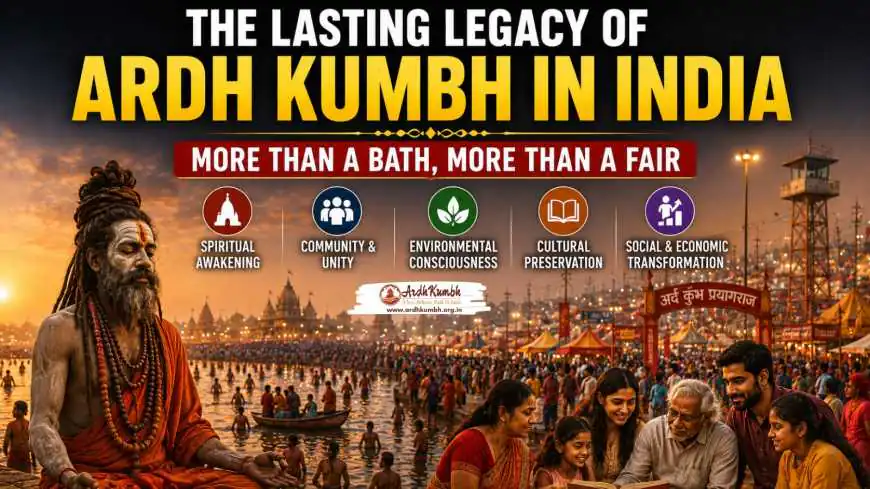
The Lasting Legacy of Ardh Kumbh in India – More Than a Bath, More Than a Fair
The lasting legacy of Ardh Kumbh in India is not just faith. It is infrastructure, economy, art, unity, and a silent thread connecting 100 crore hearts.
Beyond the Dip – What Does Legacy Even Mean at Ardh Kumbh?
Legacy is a heavy word. It means something that outlasts the event. Something that changes the place, the people, or the culture for years – sometimes generations.
At Ardh Kumbh, the legacy is not the holy dip. The water returns to its regular flow. The sadhus go back to their ashrams. The tents are sold or stored. The crowd disperses to million villages.
But India is not the same after each Ardh Kumbh. Something remains. A bridge that was not there before. A road that now connects two faraway villages. A sewage treatment plant that continues to clean the Ganga years later. A potter in a small town who learned a new craft from a visitor. A child who saw a sadhu and decided to become one. A politician who sat next to a beggar in the queue and never forgot the feeling.
That is legacy. And Ardh Kumbh leaves behind more of it than any other Indian gathering – including the full Kumbh. Why? Because Ardh Kumbh happens every six years, not twelve. That is frequent enough for lessons to be remembered and applied. And not so frequent that it becomes ordinary.
Trending Guides Now
Who Are Naga Sadhus and Why They Lead Kumbh
Read Guide →
Biggest Crowds Ever Recorded at Ardh Kumbh
Read Guide →
Significance of Bathing in the Ganges During Kumbh Mela Explained
Read Guide →
What Is the Story Behind the Ardh Kumbh Mela?
Read Guide →
Best Routes to Reach Haridwar for Ardh Kumbh Mela
Read Guide →
Ardh Kumbh 2027 Dates (Official) - Haridwar Snan Schedule
Read Guide →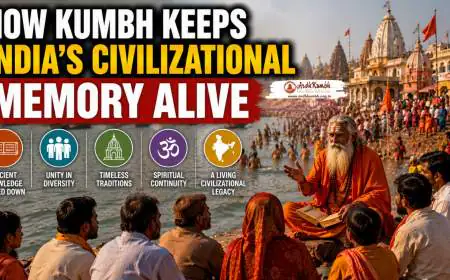
How Kumbh Keeps India’s Civilizational Memory Alive
Read Guide →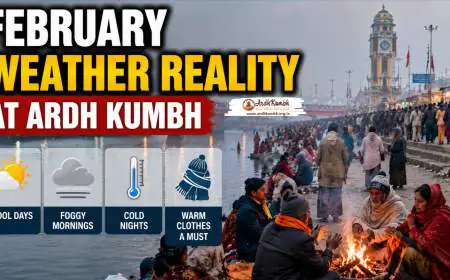
February Weather Reality at Ardh Kumbh
Read Guide →The Five Pillars of Ardh Kumbh's Lasting Legacy
1. Infrastructure Legacy – What Stays After the Tents Go
When Ardh Kumbh ends, the temporary structures are removed. But the permanent upgrades remain. Each Ardh Kumbh forces the Uttar Pradesh government and the central government to build or upgrade:
-
Roads leading to Prayagraj from neighboring districts
-
Railway platforms and waiting rooms (Prayagraj Junction gets a facelift every six years)
-
Bridges over the Ganga and Yamuna
-
Electricity substations that continue to power nearby villages
-
Sewage treatment plants along the riverfront
-
Water supply pipelines in rural areas
-
Mobile network towers in previously weak coverage zones
A farmer in a village 40 kilometers from Prayagraj may never attend Ardh Kumbh. But he will drive his tractor on a road that was built for the Kumbh crowd. A rural school will get electricity from a substation installed for the mela. A mother will give birth in a primary health center that was upgraded because the government needed to handle Kumbh emergencies.
This is the quiet legacy. The pilgrim does not see it. The villager lives it.
2. Economic Legacy – The Money That Multiplies
Ardh Kumbh brings tens of thousands of crores of rupees into the local economy. But the lasting legacy is not the money spent during the fair. It is the economic habits and infrastructure that continue to generate income for years.
-
Small hotels in Prayagraj that upgraded for Kumbh continue to attract tourists year-round
-
Local transport workers (auto drivers, taxi operators) learn customer service skills that serve them long after the crowd leaves
-
Handicraft sellers who made connections with national buyers during the mela get repeat orders for years
-
Tent manufacturers in nearby cities develop expertise that helps them win contracts for other large events across India
-
Food vendors who learned hygiene standards from langar organizers improve their own permanent shops
One chai wallah I met near Sector 5 told me: "Kumbh taught me how to make chai for five thousand people in one morning. Now my shop in town is always full. I kept the big kettle. I kept the speed."
That is economic legacy. Not a handout. A skill upgrade that pays rent for a lifetime.
3. Social Legacy – The Invisible Threads of Unity
This is the most fragile and also the most powerful legacy. India is diverse. Caste, religion, region, language, wealth – all of it divides us on a normal day.
But at Ardh Kumbh, these divisions soften. Not because of any government policy. Because of proximity. Because when you are cold and wet and tired, you do not ask the person handing you a towel about their caste. You just say thank you.
The lasting legacy of Ardh Kumbh includes:
-
Memories of shared struggle that make a Hindu from Rajasthan and a Muslim from West Bengal see each other as fellow pilgrims, not as vote banks
-
Cross-regional friendships formed in tent queues and langar lines that continue through phone calls and visits
-
Children who grow up with the memory of playing with kids from different states, speaking different languages, eating different foods – and finding it normal
-
Village communities that send a group to Ardh Kumbh together and return with a renewed sense of collective identity
One school teacher from a small town in Madhya Pradesh told me: "Before Kumbh, my students thought 'other states' were almost foreign. After I took twelve of them to Ardh Kumbh, they saw tamil, punjabi, bengali, gujarati people – all praying to the same river. Their India became real, not just a map."
That is social legacy. You cannot touch it. But you can feel it in the way India breathes a little easier with itself after every Ardh Kumbh.
4. Environmental Legacy – The River That Gets a Second Chance
This is a mixed legacy. Ardh Kumbh puts enormous pressure on the Ganga. Crores of people bathing, washing, discarding. The river suffers. But here is the counter-intuitive truth: Ardh Kumbh also forces environmental action that benefits the Ganga for years.
Because the government knows that the world is watching. International media covers Kumbh. Pollution levels are measured and reported. So in the months leading up to Ardh Kumbh, there is a massive clean-up drive:
-
Sewage plants that were lying defunct are repaired
-
Industrial discharge into the Ganga is strictly monitored
-
Single-use plastic is banned in the mela area (and the ban often continues)
-
Public toilets and waste treatment units are installed along the riverfront
-
Afforestation projects are rushed to beautify the banks
After the fair ends, many of these environmental measures remain active. The sewage plant continues to filter. The plastic ban continues in local markets. The trees continue to grow.
Is it enough? No. The Ganga is still polluted. But without Ardh Kumbh, the political will for even these temporary clean-ups would be much weaker. The river gets a breather and a boost every six years. That is a legacy worth acknowledging.
5. Cultural Legacy – Art, Music, and Stories That Travel
Ardh Kumbh is not just a religious event. It is India's largest living museum of folk art, music, storytelling, and craft.
Folk singers from remote villages get an audience of millions. Madhubani painters sell directly to buyers from Delhi, Mumbai, and even London. Storytellers narrating the Ramayana or Mahabharata in regional dialects find new listeners who carry those stories home.
The lasting legacy:
-
A weaver from Varanasi gets a bulk order from a handicraft exporter who visited Ardh Kumbh – that order feeds his family for two years
-
A young musician from a small ashram gets invited to perform in major cities after being heard at the mela
-
Traditional recipes (like Kumbh special khichdi) become famous and enter home kitchens across the country
-
Dying art forms (like puppetry or scroll painting) get a revival because they are showcased to a captive audience of lakhs
One elderly storyteller from a village near Vrindavan told me: "Before Kumbh, only my village heard my tales. After Kumbh, a professor from America recorded me. Now my voice is in a university library. I will die, but my stories will not."
That is cultural legacy. The fair ends. The art does not.
The Hidden Legacy – How Ardh Kumbh Shapes Indian Politics and Policy
This is the legacy that no one talks about openly, but everyone in power knows.
Ardh Kumbh is a dry run for disaster management. The crowd at Ardh Kumbh is larger than the population of most countries. If the government can manage three crore people in a temporary city for six weeks – with water, toilets, electricity, security, medical care, transport – then that same government has learned skills that apply to:
-
Earthquake relief
-
Flood evacuation
-
Pandemic management
-
Refugee camps
-
Large-scale political rallies
-
Olympics or Commonwealth Games (if India ever hosts)
The bureaucrats who manage Ardh Kumbh become national experts in crowd control, logistics, temporary infrastructure, and emergency response. They train others. They write manuals. They design systems that save lives in disasters years later.
Similarly, politicians learn that secularism is not just a word in the Constitution. When a Chief Minister sits in the same queue as a poor farmer, when a Prime Minister eats langar sitting on the floor, when political rivals are seen helping each other during a lost child situation – that imagery stays. It does not end communal politics. But it softens it. Just a little. Just enough for some politicians to think twice before lighting a fire of division.
That is the hidden legacy. Not written in any report. But felt in the bones of the administration.
What Ardh Kumbh Leaves Behind for the Youth of India
The younger generation of India – Gen Z and younger Millennials – are growing up in a globalized, internet-first, Western-influenced culture. Many of them have never seen traditional India up close.
Ardh Kumbh is a time machine for them. It shows them:
-
Devotion that is not performative (not for Instagram)
-
Community that is not online
-
Patience that is not a weakness
-
Simplicity that is not deprivation
-
Diversity that is not a slogan
A 19-year-old from South Delhi who attends Ardh Kumbh may complain about the dust and the cold on day one. But by day five, she is helping an elderly woman find her tent. By day seven, she is talking to a sadhu about the meaning of life. By the time she returns home, she is a slightly different human – more grounded, more curious, more grateful.
That transformation is the lasting legacy for young India. Not everyone will become spiritual. But many will become more Indian – not in a nationalist way, but in a civilizational way. They will understand that India is not just GDP and startups. It is also cold water at dawn and a billion hearts beating together in the dark.
The Legacy That Fails – Where Ardh Kumbh Could Do Better
I cannot write honestly about legacy without mentioning where Ardh Kumbh falls short.
-
Temporary workers (construction, sanitation, security) are often exploited – low wages, no contracts, unsafe conditions. Their legacy is pain, not pride.
-
Caste discrimination does not magically disappear inside the mela. Some langars still have separate queues. Some tent areas are still segregated.
-
Women's safety has improved but is not perfect. The legacy of harassment remains for some solo women who had bad experiences.
-
Environmental damage from the fair (temporary toilets leaking into the river, plastic waste, noise pollution) is real. The positive legacy of clean-up is partially undone by the negative legacy of new damage.
-
Commercialization is increasing. Corporate sponsorships, VIP tents, paid darshan – these erode the egalitarian spirit that made Kumbh special. The legacy of exclusion may grow if this continues.
A honest legacy includes both light and shadow. Ardh Kumbh has both. The question is whether the light outweighs the shadow for most people. I believe it does. But that does not mean we stop criticizing the shadow.
How the Lasting Legacy Reaches Indians Who Never Attend
Most Indians will never go to Ardh Kumbh. Too far. Too expensive. Too crowded. Too busy with farming or factory work.
But the lasting legacy still reaches them. How?
-
Television coverage of Ardh Kumbh brings the energy, colors, and devotion into crores of homes. A farmer in a remote Punjab village watches the Shahi Snan on his small TV. He feels connected to something larger than his field.
-
School textbooks mention Kumbh Mela as a national festival. Children learn about it even if they never see it.
-
Bollywood films and regional cinema have referenced Kumbh for decades. A song, a scene, a dialogue – these carry the spirit of the fair into the popular imagination.
-
News articles and documentaries about Ardh Kumbh circulate on social media. A young person in Chennai may never visit Prayagraj, but she will read about the sadhus, the langars, the crowd. That reading plants a seed.
Legacy does not require physical attendance. It requires cultural memory. Ardh Kumbh has that in abundance.
Frequently Asked Questions