
































































Where Ardh Kumbh Began: Sanatan Roots Explained Clearly
Discover where Ardh Kumbh began, its Sanatan roots, Vedic origins, sacred rivers, and why this ancient tradition still guides millions today.

Where Ardh Kumbh Began: Its Roots in Sanatan History
Ardh Kumbh is not an event invented by administration, calendars, or tourism boards. It is a civilizational memory, carried silently through centuries of Sanatan Dharma, flowing like an underground river beneath India’s visible history. To understand where Ardh Kumbh began, one must step beyond dates and banners and enter the worldview of ancient Bharata, where time, cosmos, rivers, and human life moved in one sacred rhythm.
In Sanatan thought, history is not linear. It is cyclical. Just as the sun rises and sets, and just as the planets return to familiar positions, spiritual gatherings also recur when cosmic conditions ripen. Ardh Kumbh was born from this understanding, not as a festival, but as a response to time itself.
Attending the next Ardh Kumbh?
Get official dates, snan rules, Akharas, and planning guidance in our complete event guide.
→ Ardh Kumbh Mela 2027 Complete Guide
Sanatan Civilization and the Idea of Sacred Time
Ancient Sanatan society did not separate religion, science, and daily life. Astronomy guided agriculture. Rituals followed planetary movements. Rivers were not resources; they were living, conscious presences. Within this worldview, large spiritual congregations occurred only when nature and cosmos aligned.
Trending Guides Now

What Is the Story Behind the Ardh Kumbh Mela?
Read Guide →
The Untold Stories of Har Ki Pauri
Read Guide →
How Akharas Were Formed and Why They Matter
Read Guide →
How Saints and Sadhus Define the Ardh Kumbh Tradition
Read Guide →
Best Routes to Reach Haridwar for Ardh Kumbh Mela
Read Guide →
Ardh Kumbh 2027 Dates (Official) - Haridwar Snan Schedule
Read Guide →
How Kumbh Keeps India’s Civilizational Memory Alive
Read Guide →
February Weather Reality at Ardh Kumbh
Read Guide →The roots of Ardh Kumbh history lie in this belief that certain moments amplify spiritual effort. Scriptures speak of periods when tapasya, daan, snan, and satsang yield multiplied results. These were not symbolic ideas. They were practical instructions for living in harmony with the universe.
Ardh Kumbh emerged as a mid-cycle spiritual convergence, marking a powerful interval between two Maha Kumbhs, when seekers could realign themselves without waiting an entire generation.
To truly experience the spiritual power of Ardh Kumbh, every devotee should explore Shahi Snan rituals and Akhara traditions, which explain the sacred bathing process, monastic discipline, and ancient customs that shape this holy gathering. This guide helps pilgrims connect deeply with the true essence of the Mela.
The Vedic Foundations of Kumbh Tradition
The earliest references connected to Kumbh traditions appear indirectly in Vedic and post-Vedic literature, where sacred rivers, planetary influence, and collective rites are repeatedly emphasized. While the exact term “Ardh Kumbh” evolved later, the practice it represents is far older.
Texts describe sages gathering at river confluences during specific astronomical alignments to:
-
Renew spiritual vows
-
Transmit oral knowledge
-
Perform collective yajnas
-
Guide householders and kings
These gatherings were functional spiritual assemblies, not spectacles. Over time, as society expanded and populations grew, these assemblies took a recognizable form, eventually known as Kumbh and Ardh Kumbh.
From the divine legend of Samudra Manthan to today’s massive spiritual gatherings, the History of Ardh Kumbh Mela reflects centuries of faith and devotion. This sacred festival continues to unite millions at holy rivers, blending ancient mythology with modern pilgrimage
The Central Role of Sacred Rivers
To ask where Ardh Kumbh began is also to ask where Sanatan civilization placed its faith. The answer flows through India’s rivers.
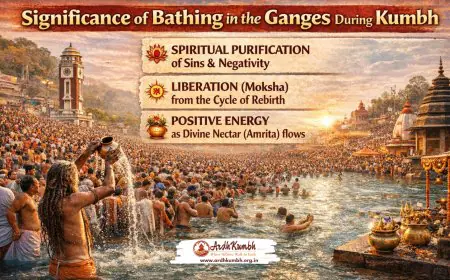
Rivers like the Ganga, Yamuna, Kshipra, and Godavari were considered bridges between earthly and cosmic realms. Bathing during specific planetary positions was believed to cleanse not only physical impurities but also karmic residue.
Ardh Kumbh became anchored to these rivers because they were already spiritual arteries of the land. When planetary alignments intensified their sanctity, sages chose these locations for mass spiritual renewal.
This is why Ardh Kumbh could only arise in a civilization that saw nature as sacred intelligence, not as inert matter.
Ardh Kumbh as a Sanatan Continuum, Not an Invention
A common modern misunderstanding is to treat Ardh Kumbh as a “smaller version” of Maha Kumbh. In Sanatan understanding, this is incorrect.
Ardh Kumbh is a continuation, not a reduction.
It exists because spiritual momentum cannot be paused for twelve years. Human life is fragile. Generations change. Ardh Kumbh ensured that knowledge, discipline, and collective purification remained alive between major cycles.
This continuity is one of the reasons Sanatan Dharma survived invasions, cultural disruptions, and political upheavals. The tradition renewed itself regularly, without central authority, through gatherings like Ardh Kumbh.
The Role of Akharas and Ascetic Lineages
As Sanatan society evolved, organized ascetic orders known as Akharas emerged to preserve discipline, philosophy, and ritual accuracy. These Akharas did not create Ardh Kumbh; they protected its purity.
During Ardh Kumbh, Akharas:
-
Conducted philosophical debates
-
Initiated new ascetics
-
Preserved oral traditions
-
Guided pilgrims in correct ritual practice
This ensured that Ardh Kumbh remained anchored in authentic Sanatan values, not diluted by trends or political influence.
Why Ardh Kumbh Could Only Arise in Sanatan Dharma
No other civilization developed a spiritual gathering of this scale, frequency, and continuity. The reason is simple.
Sanatan Dharma views liberation as a collective possibility, not just an individual pursuit. When millions gather with shared intent, the spiritual field intensifies. Ardh Kumbh is the institutional expression of this belief.
Its roots lie in:
-
Cyclical time philosophy
-
Advanced astronomical knowledge
-
River-centric sacred geography
-
Guru-shishya transmission systems
-
Community-based spiritual responsibility
Remove any one of these, and Ardh Kumbh cannot exist.
From Ancient Roots to Living Tradition
Despite modern infrastructure, digital communication, and changing lifestyles, Ardh Kumbh continues to draw millions. This is not nostalgia. It is civilizational instinct.
People arrive not just to bathe, but to reconnect with something older than memory. When they step into the river, they step into a lineage that began thousands of years ago, when the first sages looked at the sky, the water, and human suffering, and designed a system of renewal.
That system is Ardh Kumbh.
Ardh Kumbh did not begin at a date.
It began when Sanatan civilization learned to listen to time.
And it continues because time still speaks.
Frequently Asked Questions