







































Can Ardh Kumbh Be Understood Without Rituals?
Can you truly grasp Ardh Kumbh without any rituals? Yes. Here is how philosophy, energy, and cosmic science work even if you never take a dip.
What If You Just Stand There and Do Nothing?
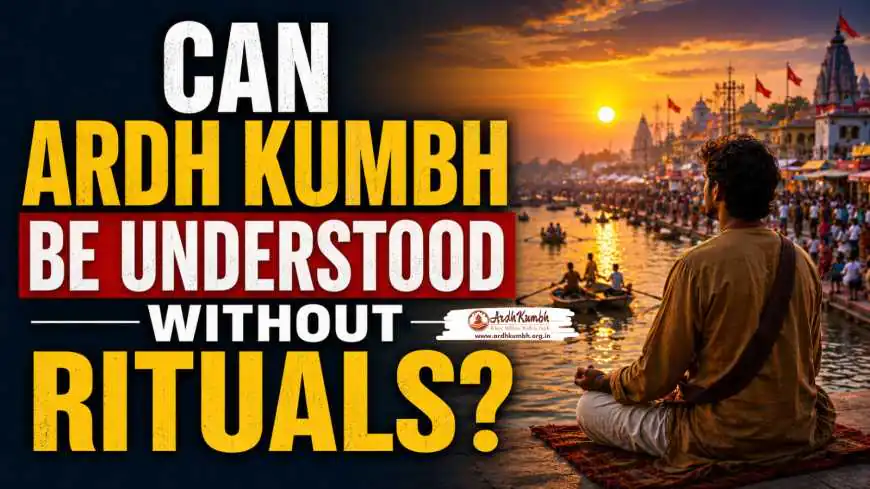
Let me ask you something honest. Have you ever felt left out because you don’t perform rituals? No mantras on your lips. No sankalpa in your heart. No priest guiding your every move. Just you, standing at the edge of a holy river during Ardh Kumbh, wondering if any of this magic can reach someone like you. Here is the truth that no pandit will shout from a microphone: Yes. You can absolutely understand the Ardh Kumbh without a single ritual. Not only that – sometimes the person without rituals understands it better than the person drowning in offerings and chants. Because the core of Ardh Kumbh is not the dipping of your body. It is the awakening of your awareness. And awareness does not need a script. It needs presence. In this article, I am not going to tell you to bring coconuts or flowers or holy threads. I am going to tell you how a skeptic, an agnostic, a curious wanderer, or simply a tired human being can stand at the Sangam during Ardh Kumbh and feel something real – without chanting a single Sanskrit word. Let me show you the ritual-free door to the oldest pilgrimage on Earth.
The First Misunderstanding – Rituals Are Not the Destination
Most people think rituals are the whole point of Ardh Kumbh. Take a dip. Offer water to the Sun. Circle a sacred tree. Feed a brahmin. Done. Pilgrimage complete. But that is like saying the whole point of food is the fork. The fork helps you eat, but the nourishment happens inside your cells. Similarly, rituals are tools – not the goal. The goal of Ardh Kumbh is inner shift. A change in how you see life, death, time, and yourself. And that shift can happen whether you dip or not. In fact, many sadhus will tell you that a person who stands at the ghat with a quiet mind and no ritual is sometimes closer to the truth than the person who goes through twenty-two steps of ceremony but whose mind is still busy calculating merit. The nectar of Ardh Kumbh does not check your ritual certificate before it enters your soul. It enters through the door of your attention. And attention costs nothing. No ghee. No incense. No donation. Just you, being still, in a place where the cosmos has decided to pour grace.
What Remains When You Remove Every Ritual
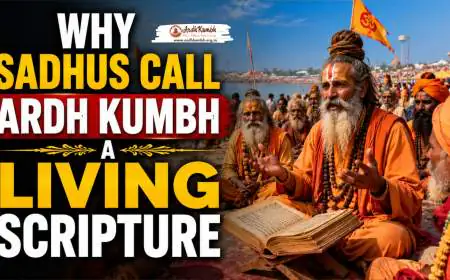
Imagine this. You are at Prayagraj during Ardh Kumbh 2027. You wake up at 4 AM. You walk to the Triveni Sangam. You do not carry a copper pot. You do not chant Gayatri mantra. You do not hire a panda (priest). You simply stand at the edge of the water. What remains? Everything that matters. The sound of the river still flows. The cold wind still touches your face. The stars still fade as the Sun rises. The millions of other pilgrims still move around you like a living river of hope and surrender. You can still see the Naga sadhus walking with their trishuls, their bodies painted with ash, their eyes looking at something you cannot name. You can still feel the energy of the place – heavy, ancient, humming like a deep bell that has been ringing for thousands of years. You can still cry without knowing why. You can still laugh without any reason. You can still hug a stranger because something in you has melted. None of this requires a ritual. This is raw humanity meeting raw sacredness. This is the Ardh Kumbh that the scriptures talk about – not the one the tourist guides sell you. The ritual is just a language. The experience is the real thing.
The Cosmic Science Works Whether You Believe or Not
Here is something that will surprise you. The planetary alignment that creates the Ardh Kumbh does not care if you believe in planets. Jupiter will move into Taurus in 2027 whether you chant mantras or scroll Instagram. The gravitational pull of the Sun and Moon on the Ganga will still create a subtle energy field that yogis have measured through inner technology for centuries. This is not magic. This is cosmic science that our ancestors understood without telescopes. During Ardh Kumbh, the electromagnetic field of the earth at certain river confluences shifts. Sensitive people can feel it as a tingling on their skin or a sudden stillness in their mind. You do not need to perform a fire ritual to receive that. You just need to be there. Think of it like sunlight. Does the sun ask you to chant before it warms your skin? No. It warms you anyway. Similarly, the energy of Ardh Kumbh falls on everyone who enters that sacred geography – the believer, the doubter, the curious, and the clueless. The rituals are just human attempts to align with that energy. But the energy does not wait for your attempt. It simply is.
Trending Guides Now
What Is Ardh Kumbh Mela? Meaning, History & Significance
Read Guide →
Who Decides Ardh Kumbh Dates and Why They Never Change
Read Guide →
Why It’s Called Ardh Kumbh: The Real Meaning
Read Guide →
Is Ardh Kumbh a Form of Tapasya?
Read Guide →
Best Routes to Reach Haridwar for Ardh Kumbh Mela
Read Guide →
Ardh Kumbh 2027 Dates (Official) - Haridwar Snan Schedule
Read Guide →
How Ardh Kumbh Stayed Relevant Over Centuries
Read Guide →
Why Early Mornings Are Sacred
Read Guide →The Skeptic’s Guide to Feeling the Ardh Kumbh
Let me speak directly to the skeptic reading this. You who needs proof. You who laughs at miracle stories. You who thinks Kumbh Mela is just crowd psychology and mass hysteria. I respect you. Because honest doubt is closer to truth than fake faith. Here is what you can do at Ardh Kumbh without any ritual. First, go to the Sangam at dawn. Do not bathe. Just sit on the steps for one hour without your phone. Notice your breath. Notice how it slows down without you trying. Notice how the noise of the crowd starts to sound like a single heartbeat instead of chaos. Second, watch the Naga sadhus from a distance. Do not take photos. Do not judge. Just watch. Notice how they move. Notice their eyes. You will see something that is not acting. You will see a stillness that your mind cannot explain. Third, walk through the tent city at night. Listen to the bhajans from different akharas – not as religious music, but as human voices raised to something larger than themselves. You may feel a lump in your throat. That lump is not religion. That lump is recognition – of suffering, of hope, of the beautiful madness of being alive. That is the Ardh Kumbh without a single ritual. That is understanding without belief.
The Role of Intention Over Ritual
Here is a secret that the priests rarely tell you. In spiritual terms, intention (sankalpa) is far more powerful than ritual. A ritual without intention is an empty shell – like a wedding without love. But intention without ritual is still a seed that can grow. So if you come to Ardh Kumbh with a quiet intention – “I want to heal this wound inside me” or “I want to understand why I am afraid of death” or even just “I want to feel something real” – that intention will work on you. The place will respond. The water will hear you even if you do not touch it. The air will carry your wish even if you do not chant it. Because Ardh Kumbh is not a vending machine where you put in rituals and get out blessings. It is a living field of consciousness that responds to sincerity – no matter what form that sincerity takes. So leave your guilt at home. You do not need to pretend to be religious. You just need to be honest. And honesty is the only ritual that has ever worked.
How the Water Speaks Without Mantras
Let me tell you something that happened to a friend of mine. He is an atheist. No god. No afterlife. No karma. But he went to Haridwar during Ardh Kumbh because his mother was dying and she asked him to bring Ganga water. He stood at Har Ki Pauri with an empty bottle, surrounded by chanting pilgrims, feeling like a fraud. He filled the bottle in silence. No mantra. No prayer. No ritual. As he turned to leave, he felt a tear roll down his cheek. He could not explain it. He was not sad. He was not happy. He was just… open. Something in him had softened. Later, his mother held that bottle and smiled before she passed. He told me, “I still don’t believe in god. But I believe in that moment.” That is the water of Ardh Kumbh. It speaks a language older than mantras. It speaks in tears, in silence, in the strange peace that visits you when you stop pretending. You do not need to ritualize the water. You just need to meet it. And it will meet you back.
The Philosophical Core – Non-Doing Is Also a Path
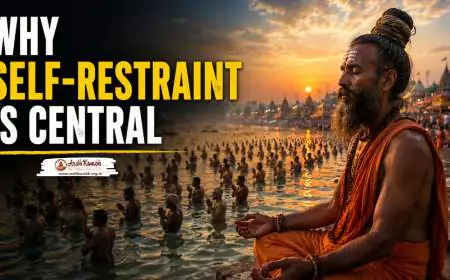
Here is a spiritual principle that most people miss. In eastern philosophy, there is a concept called nishkama karma – action without attachment to results. But there is also a deeper concept: akarma – non-action that is more powerful than action. Standing at the Sangam without doing any ritual is akarma. You are not trying to earn merit. You are not trying to please any deity. You are not trying to wash away sins. You are just there. And in that just being there, you are actually more aligned with the spirit of Ardh Kumbh than someone who is busily performing rituals to get something. Because Ardh Kumbh at its core is not about getting. It is about letting go. Letting go of your plans. Letting go of your control. Letting go of your need to understand. And when you stand there with no ritual, you have already let go of the biggest thing – the need to perform. That surrender is the highest ritual of all. Even if you never touch the water, the water has touched you.
Stories of Non-Ritualistic Pilgrims Who Got Transformed
Let me share more stories because stories prove what arguments cannot. There was a businessman from Mumbai. Stressed. Rich. Empty. He came to Ardh Kumbh because his doctor told him to take a break. He had no interest in religion. He sat on a rock near the Sangam for three days – just watching. He did not bathe. He did not pray. On the third evening, he saw an old sadhu feeding stray dogs. Something about that simple act broke him open. He started crying and could not stop. He went home a different man – started a charity, reduced his business hours, spent more time with his children. No ritual. Just seeing. Another story: a teenage girl from London, born to Indian parents but feeling disconnected from her roots. She went to Ardh Kumbh to “see what the fuss was about.” She wore earphones the first two days. On the third day, her phone died. She sat by the Ganga with nothing to do. A Naga sadhu looked at her and smiled – not at her, but through her. She felt seen for the first time in years. She later wrote, “I don’t believe in Hinduism. But I believe that man saw my soul.” That is the Ardh Kumbh beyond rituals. It is a mirror that shows you yourself – no puja required.
What Modern Science Says About Place and Energy
Let me put on my science hat for a moment. Researchers have studied Kumbh Mela for years. They have found that mass gatherings at sacred sites produce measurable changes in cortisol (stress hormone) and oxytocin (bonding hormone) in pilgrims – even those who do not participate in rituals. Why? Because human beings are social animals. When you stand in a crowd of millions who are all focused on something larger than themselves, your nervous system syncs with theirs. It is called emotional contagion. But there is more. The specific locations of Ardh Kumbh – river confluences – have been found to have negative ions that improve mood and reduce depression. The Ganga at Haridwar and Prayagraj has unique bacteriophages (viruses that kill bacteria) that make the water remarkably self-cleansing. Ancient people did not know the word bacteriophage. But they knew the water was special. So when you stand at the Sangam during Ardh Kumbh, you are not just in a religious place. You are in a scientifically unique environment that affects your brain, your mood, and your body – rituals or not. The air, the water, the earth, and the crowd all work on you. You cannot escape it. You can only receive it.
The Trap of Ritual Superiority – And Why It’s a Lie
Let me be blunt. Some religious people will tell you that rituals are necessary for Ardh Kumbh. They will say that without a holy dip, you have wasted your trip. They will say that without mantras, you are just a tourist. Do not believe them. This is ritual superiority – a way for middlemen (priests, guides, vendors) to make you feel incomplete so you will buy their services. The truth is that Ardh Kumbh belongs to everyone. The nectar does not discriminate. The Naga sadhus themselves will tell you that faith is more important than form. And faith does not mean belief in god. Faith means trust – trust that being present in a sacred place will do something to you, even if you cannot name it. So if someone shames you for not doing rituals, smile at them. They have mistaken the map for the territory. You are walking the land itself. That is enough.
How to Prepare for a Ritual-Free Ardh Kumbh Experience
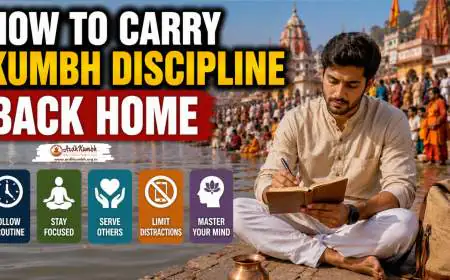
If you are now convinced that you want to experience Ardh Kumbh 2027 without rituals, here is your practical guide. First, go alone or with one quiet friend. Groups create noise and performance. Second, leave your phone in your tent for at least a few hours each day. You cannot receive if you are recording. Third, sit at the same spot on the ghat every dawn for as many days as you can. Familiarity deepens receptivity. Fourth, walk without a destination. Let your feet take you where they want. Getting lost at Ardh Kumbh is a meditation in itself. Fifth, talk to strangers – not about religion, but about life. Ask an old pilgrim why they came. Ask a young sadhu what they are seeking. Their answers will teach you more than any ritual manual. Sixth, eat simply. Fasting is a ritual – so is feasting. Instead, just eat local food with gratitude, not ceremony. Seventh, before you leave, stand at the river one last time. Say nothing. Just breathe. Let the place say goodbye to you. It will. And you will leave different – not because you did something, but because you allowed something.
The One Ritual That Even Non-Ritualistic People Cannot Avoid
Here is my final confession to you. There is one ritual that even the most anti-ritual person at Ardh Kumbh will eventually do. It is not bathing. It is not chanting. It is not offering. It is paying attention. Attention is the only universal ritual. When you pay attention to the river, you are honoring it. When you pay attention to the sadhu, you are learning from him. When you pay attention to your own breath, you are praying. Attention is the language that gods and atoms both understand. And Ardh Kumbh is a machine designed to steal your attention from your worries and place it on what matters. So do not worry about rituals. Just pay attention. To the sound of the water. To the smell of incense mixed with dust. To the feel of the cold morning air on your neck. To the sight of millions of souls all searching for the same peace. That attention is your dip. That attention is your mantra. That attention is your pilgrimage. And it is enough. More than enough.
Frequently Asked Questions