
































































Evolution of Ardh Kumbh Mela Ancient Texts, Akharas & Timeline
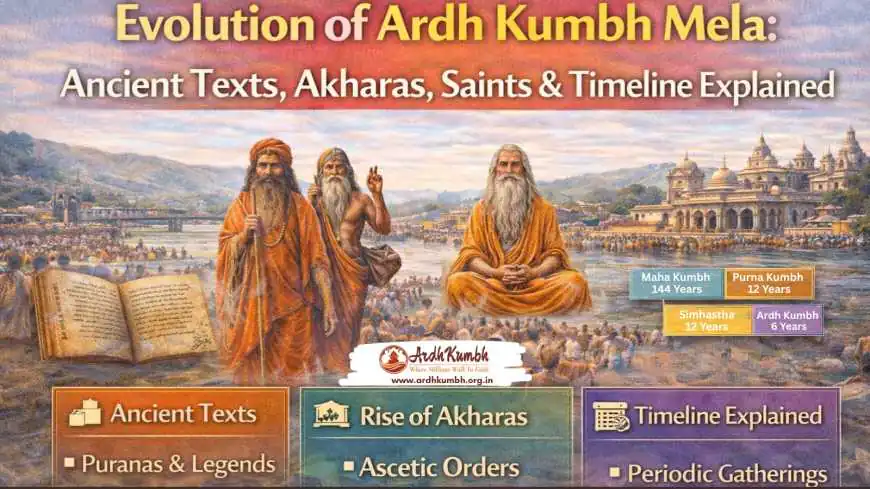
Ardh Kumbh Mela is not a static ritual but a living tradition shaped over centuries. This in-depth pillar explains the evolution of Ardh Kumbh through ancient texts, ascetic orders, Akharas, saints, and institutional continuity—showing how the pilgrimage adapted without losing its spiritual authority.
Evolution of Ardh Kumbh Mela: Ancient Texts, Akharas, Saints & Timeline Explained
Why Ardh Kumbh Is a Living Tradition, Not a Fixed Event
When people speak about the Ardh Kumbh Mela, they often imagine it as a fixed religious event repeating unchanged over centuries. This assumption is incorrect. Ardh Kumbh is not a static ritual frozen in time. It is a living civilisational system that has evolved continuously while preserving its spiritual core.
Understanding the evolution of Ardh Kumbh Mela is essential to understand why it has survived political change, social transformation, and administrative intervention without losing its religious authority. Unlike festivals that depend on rulers, calendars, or institutions, Ardh Kumbh has survived because it adapted structurally, not doctrinally.
This distinction matters.
Ardh Kumbh did not evolve by changing its beliefs. It evolved by refining how those beliefs were organised, protected, and transmitted across generations.
Trending Guides Now

Who Are Naga Sadhus and Why They Lead Kumbh
Read Guide →
Significance of Bathing in the Ganges During Kumbh Mela Explained
Read Guide →
What Is the Story Behind the Ardh Kumbh Mela?
Read Guide →
The Untold Stories of Har Ki Pauri
Read Guide →
Best Routes to Reach Haridwar for Ardh Kumbh Mela
Read Guide →
Ardh Kumbh 2027 Dates (Official) - Haridwar Snan Schedule
Read Guide →
How Kumbh Keeps India’s Civilizational Memory Alive
Read Guide →
February Weather Reality at Ardh Kumbh
Read Guide →Want to experience Ardh Kumbh in person?
Get official dates, snan guidelines, Akharas, and travel planning tips in our dedicated event guide.
→ Ardh Kumbh Mela 2027 Complete Guide
Evolution vs Origin: A Necessary Distinction
Much of the existing discourse around Ardh Kumbh focuses on mythological origins. While origin explains why a tradition began, it does not explain how it continued.
This pillar focuses on evolution, not origin.
-
Origin explains symbolism
-
Evolution explains survival
Ardh Kumbh’s continued relevance lies not in a single ancient moment, but in its ability to reorganise itself repeatedly in response to changing realities—without surrendering spiritual authority.
Early Scriptural Mentions: Fluid Gatherings, Not Fixed Events
In early Hindu textual traditions, large religious gatherings were referenced conceptually, not calendrically. Ancient texts refer to sacred rivers, auspicious periods, and collective acts of purification, but they rarely describe rigid, centrally controlled events.
This is important.
Early references suggest that:
-
gatherings were contextual, not scheduled
-
authority was ascetic, not political
-
participation was voluntary, not regulated
What we now recognise as Ardh Kumbh existed in early periods as recurring congregational practices, not as a formally named event with administrative boundaries.
This fluidity allowed the tradition to grow organically.
Also Read | Ardh Kumbh 2027 Official Dates (Haridwar)
From Individual Asceticism to Collective Congregation
One of the most significant evolutionary shifts in Ardh Kumbh was the transition from individual ascetic practice to collective spiritual gathering.
In early periods:
-
ascetics practiced tapasya near rivers
-
gatherings were small and informal
-
spiritual authority was individual
Over time, practical realities changed:
-
increasing numbers of ascetics
-
need for lineage recognition
-
necessity of mutual protection
This led to structured congregation.
Ardh Kumbh evolved not because ascetics wanted scale, but because scale became unavoidable.
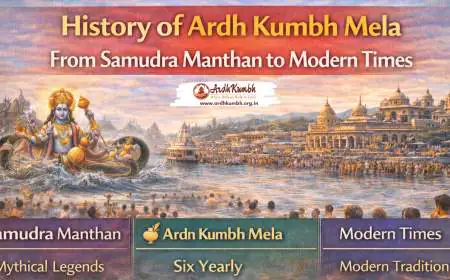
From the divine legend of Samudra Manthan to today’s massive spiritual gatherings, the History of Ardh Kumbh Mela reflects centuries of faith and devotion. This sacred festival continues to unite millions at holy rivers, blending ancient mythology with modern pilgrimage
Why Structure Became Necessary
As gatherings grew, three pressures emerged:
-
Discipline – to prevent chaos
-
Continuity – to preserve teachings
-
Order – to avoid conflict
These pressures did not come from rulers or states. They emerged from within the ascetic community itself.
This internal pressure is what makes Ardh Kumbh’s evolution unique. Its organisational framework was not imposed—it was self-generated.
The Emergence of Institutional Memory
Another key evolutionary development was the shift from oral memory to institutional memory.
Originally:
-
teachings were passed orally
-
authority rested with individuals
-
continuity depended on lifespan
Over centuries, this model proved fragile.
The solution was not scripture alone, but institutional continuity—lineages, orders, and disciplined transmission systems that could outlive individuals.
This necessity directly led to the formation of structured ascetic orders.
To truly experience the spiritual power of Ardh Kumbh, every devotee should explore Shahi Snan rituals and Akhara traditions, which explain the sacred bathing process, monastic discipline, and ancient customs that shape this holy gathering. This guide helps pilgrims connect deeply with the true essence of the Mela.
Why Ardh Kumbh Did Not Become Temple-Centric
Unlike many Hindu practices that evolved around temples, Ardh Kumbh remained river-centric.
This was a deliberate evolutionary choice.
-
temples imply permanence
-
rivers imply movement and renewal
-
temples centralise authority
-
rivers preserve collective access
By remaining river-based, Ardh Kumbh avoided being absorbed into temple administration or royal patronage.
This decision protected its independence.
The Role of Sacred Geography in Evolution
Sacred geography played a critical role in shaping Ardh Kumbh’s evolution.
Certain locations:
-
naturally attracted ascetics
-
lay outside permanent urban control
-
allowed temporary settlement
This geography made it possible for Ardh Kumbh to:
-
assemble temporarily
-
disperse peacefully
-
avoid permanent institutional capture
The event’s temporary nature is one of its greatest evolutionary strengths.
Why Ardh Kumbh Could Adapt Without Losing Authority
Many religious traditions weaken when they adapt. Ardh Kumbh did not.
The reason is simple:
-
beliefs remained constant
-
structures evolved gradually
-
authority stayed ascetic
Adaptation happened at the level of organisation, not theology.
This distinction ensured that evolution never felt like dilution.
Also Read | History of Ardh Kumbh Mela In Detailed
Early Signs of Organised Order
Long before formal documentation, Ardh Kumbh gatherings already displayed:
-
informal precedence systems
-
respect-based hierarchy
-
ritual sequencing
These early systems later evolved into clearly defined structures, but their roots were already present.
Nothing was sudden. Everything was gradual.
Why Understanding This Evolution Matters Today
Modern observers often judge Ardh Kumbh using contemporary expectations—efficiency, scale, logistics. This leads to misunderstanding.
Ardh Kumbh was never designed for convenience. It was designed for continuity.
Understanding its evolution explains:
-
why discipline is strict
-
why authority is decentralised
-
why rituals override logistics
-
why adaptation never feels artificial
Without this understanding, Ardh Kumbh appears chaotic. With it, the system reveals itself as deeply ordered.
From Solitary Ascetics to Organised Orders
How Akharas Reshaped the Structure of Ardh Kumbh Mela
The most decisive transformation in the evolution of Ardh Kumbh Mela occurred when ascetic life shifted from individual spiritual pursuit to organised collective discipline. This transition did not happen suddenly, nor was it imposed by any political or religious authority. It emerged organically from the internal needs of the ascetic community itself.
To understand Ardh Kumbh today, one must understand why Akharas came into existence and how they permanently reshaped the structure, discipline, and continuity of the gathering.
The Limits of Solitary Asceticism
In early phases, ascetic practice was largely individual:
-
renunciates lived near rivers
-
authority rested on personal austerity
-
spiritual recognition was informal
This model worked when numbers were small. As participation grew, serious limitations emerged.
Solitary asceticism could not:
-
protect spiritual lineages
-
ensure ritual consistency
-
prevent conflict during large gatherings
-
preserve teachings beyond one lifetime
Ardh Kumbh gatherings were becoming larger, but their organisational capacity remained fragile.
This imbalance made evolution inevitable.
Why Collective Discipline Became Necessary
As ascetic gatherings expanded, three unavoidable realities emerged:
Continuity
Teachings needed to survive beyond individual lifespans.
Discipline
Ritual conduct required shared standards.
Recognition
Lineages needed clarity to prevent disputes.
These pressures did not come from rulers or administrators. They came from ascetics themselves, responding to scale and responsibility.
The answer was organisation without centralisation.
The Emergence of Akharas as Institutional Anchors
Akharas did not begin as power centres. They emerged as disciplinary frameworks.
Their original purposes were simple but essential:
-
training ascetics
-
preserving lineage
-
maintaining ritual order
-
protecting spiritual autonomy
Over time, Akharas became the structural backbone of Ardh Kumbh Mela.
Importantly, they did not replace individual spiritual authority. They channelled it.
Also Read | Ardh Kumbh Explained for First-Time Pilgrims
Why Akharas Were Ascetic, Not Temple-Based
One of the most critical evolutionary decisions was keeping Akharas independent of temples.
Temples imply:
-
permanent infrastructure
-
donor dependency
-
administrative capture
Akharas, by contrast:
-
remained mobile
-
functioned through discipline, not property
-
avoided state or royal control
This mobility ensured that Ardh Kumbh remained a temporary, river-based congregation, not a temple-controlled institution.
Hierarchy Without Centralisation
A defining feature of Akhara evolution is that hierarchy exists without a central governing body.
Each Akhara:
-
governs its own discipline
-
maintains internal hierarchy
-
follows shared but unwritten conventions
There is no supreme Akhara authority.
This decentralised model prevented:
-
power concentration
-
political capture
-
doctrinal rigidity
It also allowed Ardh Kumbh to adapt locally while remaining spiritually unified.
How Akharas Introduced Order Without Formal Law
One of the most misunderstood aspects of Ardh Kumbh is how order is maintained without codified law.
Akharas introduced:
-
precedence systems
-
ritual sequencing
-
behavioural discipline
These rules were not written statutes. They were living conventions, enforced through respect, lineage authority, and shared responsibility.
This model proved more resilient than formal legal systems.
The Evolution of Ritual Precedence
As multiple Akharas began participating together, questions of precedence naturally arose:
-
who leads rituals
-
who enters sacred spaces first
-
how disputes are resolved
Rather than force uniformity, Akharas developed negotiated precedence based on:
-
lineage
-
historical presence
-
mutual recognition
This flexible hierarchy reduced conflict while preserving dignity.
Also Read | Next Ardh Kumbh Mela in Haridwar?
Why Akharas Became Custodians, Not Owners
A crucial distinction must be made:
Akharas became custodians of ritual, not owners of Ardh Kumbh.
They do not:
-
own the event
-
control participation
-
dictate belief
They ensure continuity and discipline, nothing more.
This custodial role allowed Ardh Kumbh to remain inclusive while still ordered.
Transmission of Authority Across Generations
Akharas solved one of the oldest problems in spiritual traditions: succession.
Through:
-
guru–shishya lineage
-
disciplined initiation
-
structured training
authority could be transferred without fragmentation.
This ensured that Ardh Kumbh did not reset with each generation but accumulated memory.
Why This Evolution Was Invisible but Permanent
Unlike political or institutional reforms, Akhara evolution happened quietly.
There were:
-
no declarations
-
no founding charters
-
no singular turning points
Yet the impact was permanent.
By the time Ardh Kumbh reached wider public visibility, its internal structure was already stable.
Ardh Kumbh as a Self-Regulating System
With Akharas in place, Ardh Kumbh evolved into a self-regulating spiritual system:
-
ascetics regulated ascetics
-
ritual order was internally maintained
-
disputes were resolved without state intervention
This self-regulation is why Ardh Kumbh could survive political transitions without collapse.
Why This Structure Still Holds Today
Modern observers often assume that large events require external control to function. Ardh Kumbh disproves this assumption.
Its core structure remains:
-
ascetic-led
-
decentralised
-
lineage-based
Modern administration supports logistics, but spiritual order still flows from Akharas.
That balance is not accidental. It is the result of centuries of structural evolution.
Also Read | Daily Spiritual Practices Seen at Ardh Kumbh
What This Means for Understanding Ardh Kumbh
Without understanding Akharas:
-
Ardh Kumbh appears chaotic
-
discipline appears arbitrary
-
hierarchy appears unclear
With this understanding, the system reveals itself as:
-
deeply ordered
-
historically tested
-
evolutionarily refined
Akharas are not an addition to Ardh Kumbh. They are the reason it still exists.
Saints, Mahants, and Lineages
How Human Continuity Preserved Ardh Kumbh Across Centuries
If Akharas provided the structure of Ardh Kumbh, it was saints, mahants, and living lineages that gave it continuity. Institutions alone do not survive centuries of upheaval. What sustained Ardh Kumbh through political change, social disruption, and administrative shifts was a human system of transmission—quiet, disciplined, and resilient.
This is one of the least understood aspects of the evolution of Ardh Kumbh Mela.
Why Texts and Rules Were Not Enough
Many religious traditions rely heavily on written codes, charters, or central authorities. Ardh Kumbh did not. Written texts explained philosophy, but they could not guarantee practice.
What Ardh Kumbh required was:
-
consistency without centralisation
-
authority without enforcement
-
memory without documentation
These needs could only be met through people, not paper.
Saints as Carriers of Living Memory
In the evolutionary history of Ardh Kumbh, saints were not reformers or founders. They were carriers.
Their role was to:
-
embody discipline
-
transmit ritual conduct
-
preserve unwritten conventions
-
maintain continuity through example
This living memory ensured that Ardh Kumbh practices were not reinvented by each generation.
The Role of Mahants in Organisational Stability
As ascetic communities grew, informal authority alone was insufficient. This led to the emergence of mahants—not as rulers, but as anchors of stability.
Mahants:
-
represented continuity within Akharas
-
ensured internal discipline
-
mediated disputes
-
safeguarded lineage traditions
Their authority was relational, not coercive. It existed because of recognition, not enforcement.
Lineage Over Individual Influence
A defining feature of Ardh Kumbh’s evolution is that lineage mattered more than personality.
Individual saints were respected, but:
-
authority did not end with them
-
practices were not personalised
-
rituals were not altered for charisma
Lineage ensured that Ardh Kumbh remained stable even when influential figures passed away.
This prevented fragmentation.
Guru–Shishya Transmission as an Evolutionary Tool
The guru–shishya system was not just spiritual—it was organisational.
Through disciplined initiation:
-
conduct was standardised
-
values were internalised
-
responsibility was transferred
This system allowed Ardh Kumbh to evolve without formal training institutions, while maintaining consistency.
Why Authority Was Never Centralised
One might assume that over time, authority would consolidate. Ardh Kumbh resisted this.
There was:
-
no supreme council
-
no single lineage controller
-
no central doctrinal authority
Instead, authority remained distributed across lineages, preventing capture by any one group.
This decentralisation is one of Ardh Kumbh’s greatest evolutionary strengths.
Survival Through Political Transitions
Ardh Kumbh passed through periods of:
-
shifting political power
-
regional instability
-
changing administrative systems
Saints and mahants ensured that:
-
rituals continued quietly
-
gatherings adapted in scale
-
discipline was preserved
Because authority was not tied to rulers, Ardh Kumbh did not collapse when regimes changed.
Also Read | Har Ki Pauri Ganga Aarti Time in Haridwar
Conflict Resolution Without External Enforcement
Large gatherings inevitably generate disagreements. What makes Ardh Kumbh unique is how disputes were resolved.
Resolution relied on:
-
seniority
-
lineage respect
-
mediation by recognised mahants
There was no reliance on external enforcement unless absolutely necessary. This internal conflict-resolution system preserved dignity and continuity.
Why Saints Did Not Become Lawmakers
Another important evolutionary choice was restraint.
Saints:
-
guided practice
-
preserved discipline
-
transmitted tradition
They did not codify rigid laws.
This restraint allowed Ardh Kumbh to remain adaptable without losing coherence.
Memory Preserved Through Repetition, Not Records
Instead of written manuals, Ardh Kumbh relied on:
-
repeated participation
-
observed conduct
-
collective memory
Each gathering reinforced norms. Over time, these norms became instinctive.
This method proved more resilient than documentation.
Human Continuity as the Core Evolutionary Mechanism
What ultimately preserved Ardh Kumbh was not scale, patronage, or administration. It was human continuity.
Saints and mahants ensured:
-
no generational rupture
-
no doctrinal drift
-
no structural collapse
Their quiet role is why Ardh Kumbh feels ancient yet alive.
Why This Aspect Is Often Overlooked
Modern analysis tends to focus on:
-
dates
-
numbers
-
logistics
These are visible.
Human continuity is invisible but foundational.
Without understanding this layer, Ardh Kumbh’s survival appears accidental. In reality, it was carefully transmitted.
What This Teaches About Ardh Kumbh’s Evolution
Ardh Kumbh evolved by trusting:
-
people over paperwork
-
lineage over law
-
memory over mandate
This trust allowed it to survive conditions that dismantled many other traditions.
Ardh Kumbh Under External Rule
How the Tradition Adapted Without Being Absorbed
One of the most remarkable chapters in the evolution of Ardh Kumbh Mela is not how it was created, but how it survived external authority. Few large-scale religious traditions have passed through multiple political systems without being reshaped, regulated into irrelevance, or absorbed into state structures. Ardh Kumbh did all three—and yet remained spiritually autonomous.
This survival was not accidental. It was the result of deliberate restraint, internal discipline, and an evolutionary understanding of power.
The Challenge of External Authority
As Ardh Kumbh gatherings grew in size and visibility, they inevitably came into contact with ruling powers. Large congregations attract attention—not because of belief, but because of scale.
External authorities typically focus on:
-
public order
-
movement control
-
resource allocation
-
security
Spiritual intent is rarely their concern.
This difference in priorities created a structural tension that Ardh Kumbh had to navigate carefully.
Why Ardh Kumbh Could Not Be Controlled Directly
Despite its scale, Ardh Kumbh resisted direct control for several reasons:
-
it had no permanent headquarters
-
it had no single leadership body
-
it did not depend on state patronage
-
it dispersed naturally after completion
These features made it difficult to absorb into administrative frameworks.
Unlike temples or fixed institutions, Ardh Kumbh had no handle to seize.
Adaptation Through Non-Confrontation
A key evolutionary decision was non-confrontation.
Instead of resisting authority openly, Ardh Kumbh:
-
accepted logistical oversight
-
cooperated on safety and movement
-
retained ritual autonomy
This balance ensured survival.
Confrontation invites suppression. Cooperation without surrender preserves continuity.
Why Ritual Authority Was Never Negotiated
While logistics could be discussed, ritual authority was never ceded.
External powers might:
-
manage access
-
regulate movement
-
provide infrastructure
But they did not:
-
decide ritual order
-
determine ascetic precedence
-
alter sacred practices
This boundary was respected because it was clearly defined—and consistently maintained.
Temporary Visibility, Permanent Independence
Another evolutionary strength of Ardh Kumbh is its temporary nature.
Because the gathering:
-
assembled briefly
-
dissolved completely
-
left no permanent power centre
it avoided long-term administrative entanglement.
Once the gathering ended, authority naturally returned to its dispersed state. There was nothing to institutionalise or regulate continuously.
Why Ardh Kumbh Was Tolerated, Not Sponsored
Many traditions survive by securing patronage. Ardh Kumbh survived by avoiding it.
Sponsorship implies:
-
dependency
-
expectation
-
influence
By remaining self-sustaining through ascetic networks and voluntary participation, Ardh Kumbh avoided obligations that could compromise its autonomy.
Tolerance proved safer than patronage.
Also Read | Where Ardh Kumbh Began
Administrative Observation Without Ownership
Over time, external systems began to observe Ardh Kumbh more closely. Observation led to:
-
documentation
-
mapping of movement
-
crowd estimation
However, observation did not translate into ownership.
This distinction mattered.
The gathering was managed around, not managed from within.
Why Ardh Kumbh Was Never Legislated
One of the most significant evolutionary outcomes is that Ardh Kumbh was never formalised through law.
No statute defines:
-
who may participate
-
how rituals must occur
-
who holds authority
This absence of codification preserved flexibility.
Written law freezes practice. Ardh Kumbh needed to remain fluid to survive changing circumstances.
Conflict Avoidance Through Internal Discipline
External interference often increases when internal conflict becomes visible.
Ardh Kumbh minimised this risk through:
-
strong Akhara discipline
-
respect-based hierarchy
-
mediation by senior saints
By resolving disputes internally, the gathering avoided inviting external arbitration.
Why Scale Did Not Dilute Authority
As participation increased, one might expect dilution of control. The opposite occurred.
Larger scale increased:
-
need for discipline
-
importance of lineage
-
respect for precedence
Rather than weakening authority, scale reinforced the relevance of internal structures.
This is a rare evolutionary outcome.
The Silent Contract With Power
Over time, an unspoken understanding emerged:
-
external authorities ensure safety
-
ascetic institutions ensure spiritual order
This silent contract allowed both sides to function without overreach.
It was never written, never declared—but consistently honoured.
Adaptation Without Identity Loss
The greatest achievement of this phase of evolution is that Ardh Kumbh adapted without losing identity.
-
rituals remained unchanged
-
authority remained ascetic
-
purpose remained spiritual
Only the interface evolved.
This is the hallmark of a resilient tradition.
From Observation to Coordination
How Modern Administration Changed the Surface, Not the Soul of Ardh Kumbh
The transition from external observation to structured coordination marks one of the most visible—but least understood—phases in the evolution of Ardh Kumbh Mela. To an outside observer, modern Ardh Kumbh may appear heavily managed, mapped, and regulated. Roads are planned, crowd flows are designed, and infrastructure appears extensive.
Yet this visibility often leads to a misunderstanding: that modern administration has reshaped the essence of Ardh Kumbh. In reality, what changed was the interface, not the authority.
Why Coordination Became Inevitable
As Ardh Kumbh gatherings expanded over time, scale introduced new realities:
-
larger human movement
-
higher safety risk
-
increased sanitation needs
-
complex access patterns
These were not spiritual issues, but logistical ones.
Without coordination, the physical environment could threaten the continuity of the ritual itself. Administration became necessary not to control belief, but to protect participation.
The Clear Boundary Between Logistics and Ritual
A defining feature of modern Ardh Kumbh evolution is the explicit separation of responsibilities:
-
Administration handles logistics
-
Ascetic institutions handle ritual order
This boundary is critical.
Administration may design:
-
movement corridors
-
sanitation systems
-
emergency response
But it does not decide:
-
who performs rituals
-
ritual sequencing
-
ascetic precedence
This separation preserved spiritual autonomy while allowing scale.
Why Administration Could Not Replace Ascetic Authority
Modern governance functions through:
-
rules
-
enforcement
-
written procedures
Ardh Kumbh functions through:
-
lineage recognition
-
ritual discipline
-
unwritten conventions
These systems are fundamentally incompatible.
Rather than attempting replacement, administration evolved to support around the ascetic structure, not override it.
Infrastructure as a Protective Layer, Not a Command System
Temporary infrastructure—roads, bridges, camps—often gives the impression of central control. In reality, these systems act as a protective layer.
They exist to:
-
reduce physical risk
-
ensure basic services
-
prevent disorder
They do not define the gathering.
Once the Ardh Kumbh concludes, this layer disappears completely. Nothing permanent remains.
Why Permanence Was Carefully Avoided
A crucial evolutionary decision was to avoid permanent infrastructure dedicated exclusively to Ardh Kumbh.
Permanence creates:
-
institutional ownership
-
bureaucratic control
-
long-term dependency
By remaining temporary, Ardh Kumbh:
-
avoided administrative capture
-
preserved flexibility
-
maintained ritual independence
This was not accidental. It was evolutionary wisdom.
The Rise of Predictive Management Without Predictive Control
Modern systems introduced:
-
crowd estimation
-
movement modelling
-
safety planning
However, these tools were used to anticipate problems, not to redesign the ritual.
This distinction matters.
Prediction improved safety. Control would have altered identity.
Why Modern Coordination Did Not Dilute Sacred Authority
Many traditions weaken when they modernise. Ardh Kumbh did not.
The reason lies in where modernisation stopped.
-
it modernised movement
-
it modernised sanitation
-
it modernised emergency response
It did not modernise:
-
belief
-
ritual hierarchy
-
ascetic authority
By refusing to modernise the sacred core, Ardh Kumbh preserved legitimacy.
Decentralisation as a Strength in the Modern Era
Modern governance prefers centralised command. Ardh Kumbh retained decentralisation.
Even today:
-
no single body “runs” Ardh Kumbh
-
coordination happens across multiple systems
-
spiritual authority remains distributed
This decentralisation prevents any one institution from redefining the gathering.
Why Discipline Became More Visible, Not Less
As scale increased, discipline became more visible:
-
clearer boundaries
-
defined movement paths
-
stricter sequencing
To outsiders, this can appear restrictive. In reality, discipline is what allowed Ardh Kumbh to grow without collapsing under its own size.
Visibility of discipline is a sign of maturity, not control.
Modern Administration as a Silent Partner
Perhaps the most accurate way to describe modern involvement is this: silent partnership.
Administration works best when it:
-
remains invisible
-
supports without instructing
-
withdraws when unnecessary
Ardh Kumbh’s evolution succeeded because this balance was largely maintained.
What Did Not Change Despite Modern Coordination
Despite surface-level transformation, core elements remained untouched:
-
sacred rivers remained central
-
ascetic authority remained primary
-
ritual meaning remained unchanged
-
participation remained voluntary
This continuity confirms that evolution occurred around the tradition, not within it.
What Changed and What Never Changed
The Core Constants of Ardh Kumbh Across Time
To truly understand the evolution of Ardh Kumbh Mela, one must step back from chronology and ask a deeper question:
What changed over centuries—and what remained untouched?
This distinction reveals why Ardh Kumbh feels ancient yet relevant, structured yet fluid. Evolution did not mean replacement. It meant layering—new systems forming around an unchanged core.
What Changed: The Outer Structure of Ardh Kumbh
Change in Ardh Kumbh occurred primarily at the structural and operational level, not the spiritual one.
Scale of Participation
One of the most visible changes has been scale.
-
early gatherings were limited and dispersed
-
participation increased gradually over generations
-
large congregations became unavoidable
This growth forced adaptations in organisation, but not in purpose.
Scale expanded. Meaning did not.
Visibility and Public Awareness
Ardh Kumbh evolved from:
-
locally recognised ascetic gatherings
to -
widely known civilisational events
This visibility brought attention, documentation, and external observation. However, attention did not translate into control.
Awareness increased. Authority remained internal.
Infrastructure and Physical Arrangement
Temporary infrastructure evolved to support:
-
movement safety
-
sanitation
-
emergency response
Paths became defined, zones demarcated, and coordination improved. These changes were protective, not directive.
The physical environment changed to protect the ritual—not to reshape it.
Administrative Interface
Another major change was the introduction of formal administrative coordination.
This included:
-
crowd facilitation
-
public safety systems
-
medical and sanitation support
These systems improved physical sustainability without redefining spiritual hierarchy.
Administration entered as a service, not a command.
What Never Changed: The Inner Core of Ardh Kumbh
Despite centuries of transformation, certain elements remained untouched. These constants define Ardh Kumbh’s identity.
Primacy of Sacred Geography
At the heart of Ardh Kumbh remains:
-
the sacred river
-
the act of ritual immersion
-
the symbolism of purification
No matter how systems evolved, sacred geography remained central.
Rivers were never replaced by structures. Space was never replaced by buildings.
Ascetic Authority Over Ritual
Ritual authority always remained:
-
ascetic-led
-
lineage-based
-
decentralised
Neither kings nor administrators determined ritual order.
This continuity protected Ardh Kumbh from becoming ceremonial theatre or state ritual.
Voluntary Participation
Participation in Ardh Kumbh has always been voluntary.
There is:
-
no membership
-
no registration for belief
-
no obligation to attend
This voluntary nature preserved authenticity.
People came because of faith, not instruction.
Temporary Nature of the Gathering
Ardh Kumbh assembles—and dissolves.
There are:
-
no permanent headquarters
-
no year-round authority centres
-
no institutional ownership
This temporariness prevents ossification.
The tradition renews itself by not settling.
Unwritten Codes and Living Discipline
Rules exist—but rarely on paper.
They survive through:
-
repeated practice
-
lineage respect
-
observed conduct
Written law freezes tradition. Living discipline keeps it adaptive.
Ardh Kumbh chose the latter.
Why Change Never Crossed the Sacred Boundary
A critical reason Ardh Kumbh survived is that change was directionally disciplined.
Adaptation was allowed only where it:
-
protected participants
-
preserved continuity
-
prevented collapse
Change was rejected where it:
-
altered belief
-
centralised authority
-
replaced ascetic order
This selective evolution is rare—and powerful.
Why This Balance Is Often Misunderstood
Modern observers often interpret:
-
infrastructure as control
-
visibility as ownership
-
coordination as authority
These interpretations are incorrect.
What looks like control is actually containment—a boundary that allows the core to remain untouched.
Continuity as the True Measure of Evolution
Evolution is often mistaken for transformation.
In Ardh Kumbh, evolution meant:
-
remaining recognisable across centuries
-
allowing growth without fragmentation
-
changing form without changing essence
Few traditions manage this balance.
Why Ardh Kumbh Did Not Fragment
Many traditions splinter over time. Ardh Kumbh did not.
The reasons are clear:
-
decentralised authority
-
shared sacred geography
-
disciplined lineage transmission
-
absence of rigid codification
Fragmentation requires fixed power centres. Ardh Kumbh avoided them.
What This Teaches About Living Traditions
Ardh Kumbh demonstrates that:
-
traditions survive by adapting around their core
-
permanence weakens resilience
-
decentralisation protects meaning
Its evolution offers lessons beyond religion—about systems, memory, and continuity.
Why Ardh Kumbh Still Matters Today
Evolution as a Living Civilisational System
After tracing how Ardh Kumbh Mela evolved through texts, ascetic organisation, human lineage, external power, and modern coordination, a larger question emerges:
Why does Ardh Kumbh still matter today?
In a world defined by speed, centralisation, and institutional control, Ardh Kumbh appears almost out of place. Yet it continues to function—not marginally, but at scale. This persistence is not accidental. It reveals that Ardh Kumbh has evolved into something larger than a religious gathering: a living civilisational system.
Ardh Kumbh as a Test of Continuity
Most large traditions survive through:
-
permanent institutions
-
codified rules
-
legal authority
Ardh Kumbh survives without these.
Its continued relevance demonstrates that continuity does not always require control. It can also emerge from shared memory, disciplined participation, and collective responsibility.
This makes Ardh Kumbh a rare example of non-institutional continuity in the modern world.
Why Modern Society Still Engages With Ardh Kumbh
Despite urbanisation, digitisation, and globalisation, participation in Ardh Kumbh has not declined. This is not because of nostalgia, but because Ardh Kumbh fulfils needs that modern systems do not address.
It provides:
-
collective pause
-
ritual rhythm
-
shared humility
-
decentralised belonging
These experiences are increasingly rare elsewhere.
Ardh Kumbh and the Idea of Collective Discipline
Modern life prioritises individual choice. Ardh Kumbh prioritises collective discipline.
Participants:
-
move together
-
wait together
-
submit to shared order
This collective discipline is not enforced through law. It is internalised through tradition.
The relevance lies here: Ardh Kumbh reminds societies that order can emerge from consent, not coercion.
Why Ardh Kumbh Is Not Replaced by Technology
Technology optimises efficiency. Ardh Kumbh is not efficient—and that is precisely why it remains meaningful.
Efficiency removes friction.
Ardh Kumbh preserves it.
Friction:
-
slows movement
-
demands patience
-
enforces humility
These qualities are not flaws. They are part of the system’s purpose.
A Space Where Authority Is Earned, Not Assigned
In most modern systems, authority is assigned through position. In Ardh Kumbh, authority is earned through:
-
lineage
-
discipline
-
recognition over time
This makes authority:
-
less visible
-
more stable
-
harder to manipulate
Such authority structures remain relevant because they resist rapid erosion.
Ardh Kumbh as a Check Against Centralisation
Centralisation simplifies management but concentrates power. Ardh Kumbh evolved to avoid this.
Even today:
-
no single body defines belief
-
no central institution owns the gathering
-
no permanent hierarchy governs all participants
This decentralisation is not chaos. It is distributed stability.
In an era of centralised systems, Ardh Kumbh offers an alternative model.
Why Temporariness Is Still Powerful
Modern systems aim for permanence. Ardh Kumbh deliberately dissolves.
By assembling temporarily and dispersing fully, it:
-
avoids institutional stagnation
-
renews itself each cycle
-
prevents ownership
This temporariness is not weakness. It is a method of renewal.
Few systems understand how to end gracefully. Ardh Kumbh does.
Relevance Beyond Religion
While Ardh Kumbh is religious in nature, its evolutionary lessons extend beyond faith.
It demonstrates:
-
how large groups self-regulate
-
how tradition adapts without losing identity
-
how authority survives without enforcement
These lessons apply to communities, movements, and civilisations.
Why Ardh Kumbh Is Often Misread Today
Contemporary analysis often reduces Ardh Kumbh to:
-
crowd size
-
logistics
-
spectacle
This reduction misses the point.
Ardh Kumbh is not impressive because of scale.
It is impressive because of structural endurance.
Understanding this shifts the narrative from event coverage to civilisational insight.
Continuity Without Nostalgia
Ardh Kumbh does not survive because people romanticise the past. It survives because it continues to function.
Its practices:
-
remain intelligible
-
remain participatory
-
remain adaptable
This functional continuity is more powerful than sentiment.
Why the Evolution Is Still Ongoing
Evolution did not end with modern administration. It continues quietly.
Ardh Kumbh still adapts:
-
through negotiation
-
through consensus
-
through lived experience
There is no final form. There is only continued refinement.
This openness ensures future relevance without radical change.
What Ardh Kumbh Represents Today
Today, Ardh Kumbh represents:
-
a bridge between past and present
-
a system older than modern governance
-
a gathering that resists simplification
It stands as evidence that tradition can be dynamic without becoming unstable.
Ardh Kumbh Mela as an Evolving Continuum of Faith
A Tradition That Survived by Adapting Without Surrender
Across centuries, the Ardh Kumbh Mela has endured not because it resisted change, but because it understood where change was permissible and where it was not. This distinction—rare among large religious traditions—is the key to understanding Ardh Kumbh not as an event, but as a continuum of faith.
Evolution, in the context of Ardh Kumbh, never meant reinvention. It meant refinement.
The Evolutionary Pattern, Revisited
When viewed as a whole, the evolution of Ardh Kumbh follows a consistent pattern:
-
Belief remained constant
-
Structure adapted gradually
-
Authority stayed ascetic
-
Control was never centralised
Each phase of change—textual reference, ascetic congregation, Akhara organisation, lineage preservation, external coexistence, and modern coordination—added a layer around the core, never replacing it.
This layered evolution explains why Ardh Kumbh feels ancient yet functional, complex yet coherent.
Why Ardh Kumbh Never Collapsed
Many traditions of similar age fractured, diluted, or disappeared. Ardh Kumbh did not. The reasons are structural, not sentimental.
It avoided collapse because it:
-
never depended on permanent institutions
-
never centralised authority
-
never froze itself through rigid codification
-
never allowed ownership of the sacred
By remaining temporary, decentralised, and lineage-based, Ardh Kumbh denied history the leverage it often uses to dismantle traditions.
Institutional Strength Without Institutional Ownership
One of Ardh Kumbh’s most profound achievements is that it developed institutional strength without institutional ownership.
Akharas provided discipline without domination.
Saints and mahants provided continuity without bureaucracy.
Administration provided safety without authority.
Each system knew its boundary.
This clarity of roles prevented erosion from within and interference from outside.
Why the Absence of Dates, Laws, and Headquarters Matters
From a modern perspective, the absence of:
-
fixed legal frameworks
-
permanent headquarters
-
written constitutions
can appear as weakness.
In reality, it is Ardh Kumbh’s greatest strength.
What cannot be pinned down cannot be captured.
What is not fixed cannot easily fracture.
By resisting permanence, Ardh Kumbh preserved resilience.
Ardh Kumbh as a Model of Distributed Authority
Ardh Kumbh demonstrates a rare governance model:
-
authority is distributed, not delegated
-
discipline emerges through recognition, not enforcement
-
order exists without a single command centre
This model has allowed Ardh Kumbh to scale massively without collapsing under its own complexity.
In an era dominated by centralised systems, this distributed authority remains not only relevant, but instructive.
Why Modern Visibility Did Not Dilute Meaning
Visibility often weakens sacred traditions. Ardh Kumbh resisted this.
As participation expanded and observation increased:
-
rituals were not simplified
-
authority was not democratised
-
symbolism was not diluted
Instead, internal discipline intensified.
Visibility strengthened structure instead of eroding it—a rare evolutionary outcome.
Understanding Ardh Kumbh Beyond Pilgrimage
While Ardh Kumbh is a religious gathering, its evolutionary journey positions it as something broader:
-
a civilisational memory system
-
a living archive of ascetic discipline
-
a self-regulating collective tradition
Reducing it to tourism, logistics, or even ritual alone misses its deeper function as a carrier of continuity across time.
Why Evolution, Not Origin, Explains Ardh Kumbh’s Power
Origins explain symbolism.
Evolution explains survival.
By focusing on evolution, this pillar clarifies:
-
why Ardh Kumbh adapted without fragmenting
-
why Akharas gained authority without centralising power
-
why modern administration did not redefine spiritual order
The power of Ardh Kumbh lies not in how it began, but in how it learned to continue.
The Ongoing Nature of Evolution
Ardh Kumbh’s evolution is not complete. It remains open-ended.
Future adaptations will occur:
-
quietly
-
incrementally
-
through consensus
There will be no declarations, no reforms, no reinventions—only continued refinement.
This openness ensures relevance without rupture.
Related Ardh Kumbh Guides :
- When Is the Next Ardh Kumbh Mela in Haridwar?
- Har Ki Pauri Ganga Aarti Time in Haridwar: Complete Schedule
- Why Har Ki Pauri Becomes the Heart of Ardh Kumbh
- Ardh Kumbh vs Maha Kumbh: The Real Difference Explained
- Is Attending Ardh Kumbh Mandatory for Devotees?
- Why Ardh Kumbh Holds the Same Spiritual Weight as Kumbh
- How Ardh Kumbh Evolved Over Centuries of Faith ?
- Ancient Scriptures That Clearly Explain Ardh Kumbh
- Strict Rules Pilgrims Follow at Ardh Kumbh
- Is Ardh Kumbh Really Different From Kumbh Mela?
Frequently Asked Questions