

























































How Kumbh Knowledge Is Passed Orally
Discover how Kumbh knowledge is passed orally from guru to disciple. A heartfelt look at the living tradition of storytelling, chanting, and oral transmission.
How Kumbh Knowledge Is Passed Orally
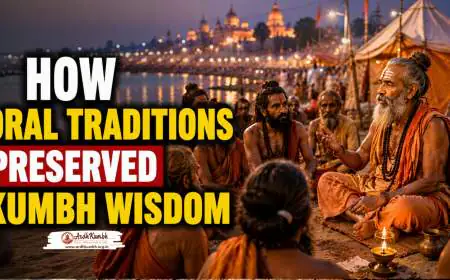
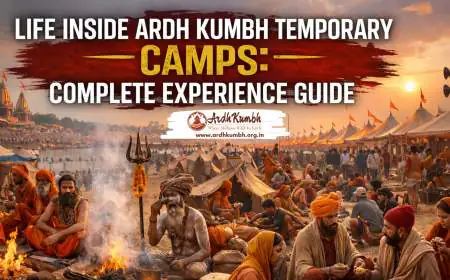
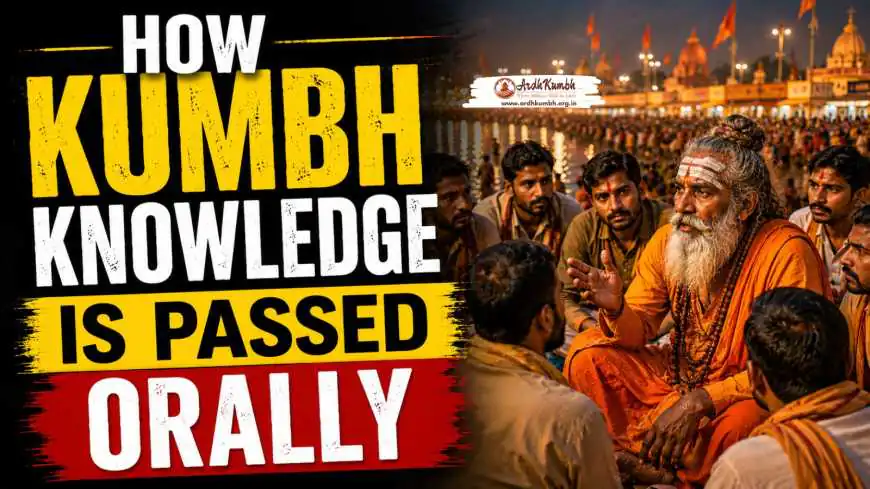
Let me start with a story that will tell you everything. I met an old sadhu at the last Ardh Kumbh. He was sitting under a tree, surrounded by six young disciples. He was not holding a book. He was not showing a chart. He was talking. And the disciples were listening — not taking notes, not recording on their phones, just listening with their whole bodies. Every few minutes, one of them would repeat a phrase back to him. The old man would nod or correct gently. This went on for hours. I asked one of the disciples later: "What are you learning?" He said: "The names of the 84 lakh yonis (8.4 million species of life) and the mantra to pray for each one." I asked: "Is it written down somewhere?" He laughed. "Why would we write it? Writing is dead. This is alive. My guru learned it from his guru, who learned it from his guru, back to Adi Shankaracharya himself. If I write it, I will forget that I am part of a chain. But if I memorize it from his voice, I am linked to every person who ever spoke these words." That is oral transmission. It is not about information. It is about relationship. It is about lineage. It is about presence. Let me show you how it works.
The Guru-Shishya Parampara – The Unbroken Chain
The foundation of oral transmission at the Kumbh is the guru-shishya parampara — the teacher-disciple tradition. In this system, knowledge is not a commodity to be bought and sold. It is a trust to be passed from one generation to the next. A guru spends years — sometimes decades — training a shishya (disciple) through living together, oral instruction, ritual participation, and silent observation. The shishya does not take notes. He absorbs. He watches how the guru walks, how he eats, how he chants, how he interacts with strangers. He memorizes mantras not by reading them, but by repeating them thousands of times until the sounds live in his bones. At the Kumbh, you see this parampara everywhere. The Naga Sadhus moving in formation behind their mahant. The young brahmacharis carrying the elder's water pot. The children repeating the aarti chant after their grandmother. This is not nostalgia. This is pedagogy. The guru-shishya parampara is one of the most effective knowledge transmission systems ever devised. It ensures that knowledge is not just memorized, but embodied. And the Kumbh is its greatest public exhibition.
The Akharas – Universities of the Voice
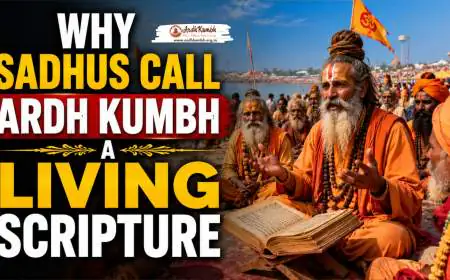
Let me talk about the akharas (sects of sadhus). Each akhara is like a living university — but without buildings, without libraries, without degrees. The curriculum is passed orally. The history of the akhara — its founders, its battles, its saints, its miracles — is preserved in stories told by the elders to the new initiates. The rules of the akhara — how to dress, how to eat, how to meditate, how to fight — are transmitted orally through demonstration and correction. The mantras and meditation techniques are given orally from guru to disciple, often in secret, never written down. Why? Because the akharas believe that written knowledge can be stolen, misinterpreted, or disconnected from its living source. But oral knowledge requires a relationship. You cannot learn the secret mantras of the Naga Sadhus from a PDF. You have to earn them. You have to sit at the feet of a guru for years. You have to prove your dedication. That barrier protects the purity of the knowledge. And it keeps the tradition alive across centuries.
The Power of Repetition – Mantras That Live in the Body
Here is the secret of oral transmission that no book can replicate. When you learn a mantra from a book, you learn it with your eyes. When you learn a mantra from a guru, you learn it with your ears, your voice, your breath, and your body. You repeat it hundreds, thousands, tens of thousands of times. The sound vibrates through your chest. Your tongue learns the precise placement. Your breath learns the rhythm. After enough repetition, the mantra becomes automatic. You do not recite it. It recites you. That is embodied knowledge. It is not in your brain. It is in your nervous system. It is in your muscles. It is in your heartbeat. The Kumbh is a place where you can witness this embodied knowledge on display. Watch the Naga Sadhus chanting. They are not reading. They are not remembering. They are being the mantra. That is the power of oral repetition. And it is the only way to truly know a mantra. Books can give you the words. Only a guru can give you the music.
Trending Guides Now
Who Are Naga Sadhus and Why They Lead Kumbh
Read Guide →
Biggest Crowds Ever Recorded at Ardh Kumbh
Read Guide →
Why Haridwar Is Spiritually Central to Ardh Kumbh
Read Guide →
How Ardh Kumbh Evolved Over Centuries of Faith ?
Read Guide →
Best Routes to Reach Haridwar for Ardh Kumbh Mela
Read Guide →
Ardh Kumbh 2027 Dates (Official) - Haridwar Snan Schedule
Read Guide →
Why Snan Dates Create Massive Spiritual Momentum
Read Guide →
How Ardh Kumbh Changes the Way You See Life
Read Guide →Stories That Carry the Ethics
Let me talk about stories. The Kumbh is full of them. Stories of why the Ganges came to Earth. Stories of how the nectar fell at four places. Stories of saints who performed miracles. Stories of pilgrims who found liberation. These stories are not just entertainment. They are ethical instruction wrapped in narrative. And they are passed orally — from parent to child, from sadhu to pilgrim, from elder to youth. A child at the Kumbh does not learn about honesty from a textbook. He learns from the story of the sadhu who refused to lie even to save his life. A young woman does not learn about patience from a lecture. She learns from the story of the mother who walked two hundred miles to the Ganges with her dying son. These stories stick because they are heard, not read. They are told with emotion, with pause, with tears, with laughter. They are tailored to the listener. They are repeated until they become part of the listener's inner voice. That is oral ethics. And it is far more effective than any written rulebook.
How the Dates Are Preserved – No Calendar Needed
Here is something that will surprise you. The Kumbh dates are astrological. They depend on the positions of Jupiter, the Sun, and the Moon. In the modern era, the government announces these dates years in advance. But how did the sadhus know when to come before there were official announcements? Oral tradition. The Naga Sadhus and the akharas have maintained oral calendars for centuries. The mahants (elders) pass down the formula for calculating the Kumbh dates to their disciples. It is a complex oral mnemonic — a set of verses that encode the astrological rules. The disciples memorize these verses. They learn to observe the sky. They learn to calculate the alignment without paper, without calculators, without phones. On the day of the Shahi Snan, they do not check a website. They check the stars. That is oral astronomy. It is real. It is accurate. And it has kept the Kumbh running for thousands of years.
The Role of the Kumbh Itself as a Transmission Event
Here is the most important point. The Kumbh Mela is not just a place where oral transmission happens. The Kumbh itself is an oral transmission event. Think about it. Millions of people gather at the same river at the same celestial moment. They bring their oral traditions from every corner of India. They exchange stories. They learn new mantras. They witness rituals that have been performed the same way for centuries. They watch the Naga Sadhus and ask questions. They listen to the katha (religious discourse) of wandering saints. They sit at the feet of mahants and receive upadesh (instruction). And then they go home and repeat what they have learned to their families, their neighbors, their villages. The Kumbh is the hub of a vast oral network. Every six years, the network synchronizes. Knowledge flows from the centers (the akharas, the sadhus, the elders) to the periphery (the ordinary pilgrims). And then the pilgrims carry that knowledge back to their homes, where it continues to circulate orally until the next Kumbh. That is how a tradition without a central text stays alive.
Why Writing Cannot Replace the Voice
Let me be clear. I am not anti-book. I love books. I write for a living. But oral transmission does things that writing cannot do. First, oral transmission is relational. You cannot learn from a voice without trusting the person who speaks. That trust changes how you receive the knowledge. Second, oral transmission is flexible. A guru can see that a disciple is confused and repeat the teaching in a different way. A book cannot do that. Third, oral transmission is embodied. It involves tone, pace, volume, silence, gesture, eye contact. A book has none of that. Fourth, oral transmission creates memory. The human brain is wired to remember stories, songs, and conversations far better than it remembers written text. That is why you can still remember the lyrics to a song from ten years ago but cannot remember what you read in a book last month. The Kumbh uses all of these advantages. The oral knowledge you receive there will stay with you longer than any book you will ever read.
The Danger of Breaking the Chain
Let me tell you what keeps the sadhus awake at night. They are afraid of broken chains. If a guru dies before passing his knowledge to a worthy disciple, that knowledge is lost forever. No book holds a backup. No cloud storage saves it. It is gone. And because so much Kumbh knowledge is esoteric (secret, given only to initiates), it cannot be written down without breaking the vow of secrecy. So the akharas are constantly watching for young people who are sincere, dedicated, and capable of memorizing vast amounts of oral material. They train them intensely. They test them relentlessly. They hope that the chain will hold for one more generation. That is the urgency of oral transmission. It is fragile. It depends entirely on human memory and human relationship. And that fragility is also its strength. Because when something is fragile, we value it. We protect it. We honor it. That is why the Kumbh still matters. Not because it is written in a book. But because it is sung in the voices of the living.
What You Can Learn – Even as a Visitor
You do not need to become a Naga Sadhu to receive oral knowledge at the Kumbh. Every pilgrim can participate. Listen to the katha of a wandering saint. Ask an elder why they have come. Watch how the Naga Sadhus interact with their gurus. Pay attention to the stories that pilgrims tell each other while waiting in line. Ask a pandit at the ghat to explain the meaning of the aarti. The oral tradition of the Kumbh is not locked away in secret caves. It is everywhere — in the conversations, the chants, the arguments, the jokes, the tears. All you have to do is listen. Not with your ears only. With your whole self. Put down your phone. Stop taking photos. Stop recording. Just be present and listen. The voices of the Kumbh have been speaking for thousands of years. They are still speaking. The question is: are you listening?
The Living River of Sound
Let me end with this. The Ganges is a river of water. But the Kumbh is a river of sound. Millions of voices, millions of stories, millions of mantras, flowing together into one continuous roar. That roar is not noise. It is knowledge. It is the accumulated wisdom of thousands of years, passed from mouth to ear, from generation to generation, from guru to disciple. You cannot capture that roar in a book. You cannot download it as a PDF. You can only stand in it. Let it wash over you. Let it enter you. And then, when you leave, let it speak through you. That is how Kumbh knowledge is passed orally. Not through pages. Through people. Not through screens. Through presence. Not through memory. Through life. The river flows. The voices flow. And as long as there is a Kumbh, the flow will never stop.
Frequently Asked Questions