


































































Why Ardh Kumbh Happens Only at Certain Sacred Places
Discover the spiritual and cosmic reasons why Ardh Kumbh occurs exclusively at four holy river banks in India. Uncover ancient secrets behind this divine gathering.

The Cosmic Blueprint Behind Sacred Gatherings
Have you ever wondered why millions of devotees, sadhus, and spiritual seekers don’t just gather anywhere for the Ardh Kumbh? Why only four specific river banks in India get the privilege of hosting this divine spectacle every six years? The answer isn’t random. It’s written in the stars, carved in ancient scriptures, and soaked into the soil of these sacred places through mythology, astrology, and spiritual science. While the full Kumbh Mela rotates every twelve years, the Ardh Kumbh—meaning “half Kumbh”—marks the six-year milestone at just two of those four locations: Prayagraj and Haridwar. But why only there? And why not in your local temple or any riverbank? Because these places carry a spiritual voltage that no other spot on Earth can match. The answer lies deep inside Hindu cosmology, where time, space, and divine energy collide to create a portal like no other. Let’s walk through this sacred geography together, not like scholars, but like curious pilgrims wanting to understand why some places simply glow differently on the spiritual map of India.
The Ancient Myth That Sealed These Places Forever
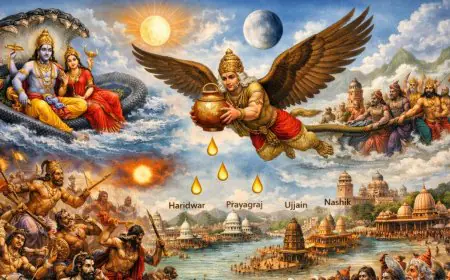
To truly understand why the Ardh Kumbh happens only at certain sacred places, we have to go back to the oldest story in Hindu mythology—the Samudra Manthan, or the churning of the ocean. Picture this: The devas (gods) and asuras (demons) once churned the cosmic ocean to extract Amrit, the nectar of immortality. After a thousand years of pulling the serpent Vasuki back and forth, fourteen divine treasures emerged. But the most precious of all was the pot of nectar. As soon as the Kumbh (pot) appeared, a fierce chase began. The demons wanted the nectar all for themselves, so Lord Vishnu disguised himself as Mohini, the enchantress, to distract them. But a few drops of Amrit fell from the pot onto four earthly spots: Prayagraj (where the Ganga, Yamuna, and mythical Saraswati meet), Haridwar (where the Ganga touches the plains), Ujjain (on the banks of the Shipra), and Nashik (on the Godavari).
Here’s where the magic happens. Those drops of nectar didn’t just wet the ground—they sanctified these places forever. According to belief, the soil, water, and air of these four locations still carry that divine essence. So when the planets align every twelve years, the energy becomes strong enough to reopen that ancient portal. The Ardh Kumbh occurs at the six-year mark between these full Kumbh cycles, but only at Prayagraj and Haridwar because those two places hold the strongest nectar energy from the original churning. Think of it like this: If the full Kumbh is a massive spiritual battery charging once every twelve years, the Ardh Kumbh is the half-charge happening at the two most power-charged locations in that cycle.
Why Not Every River Bank Qualifies for Ardh Kumbh
You might ask, “India has thousands of holy rivers—the Yamuna, Narmada, Kaveri, Brahmaputra. Why don’t they host the Ardh Kumbh?” The answer sits at the crossroads of astrology, scripture, and spiritual geography. According to ancient texts like the Puranas, only those river banks where the nectar actually touched the ground carry the permanent seed of this cosmic event. The Ganga at Haridwar is special because this is exactly where the river leaves the mountains and enters the plains—considered a threshold between the divine and the human realms. The Triveni Sangam at Prayagraj is even more unique. It’s not just one river but three—the Ganga, Yamuna, and the invisible Saraswati that exists only in the subtle realm. Meeting of three rivers is called Triveni, and such a confluence is considered twice as powerful as a single river.
Trending Guides Now
What Is the Story Behind the Ardh Kumbh Mela?
Read Guide →
The Untold Stories of Har Ki Pauri
Read Guide →
How Saints and Sadhus Define the Ardh Kumbh Tradition
Read Guide →
Ancient Scriptures That Clearly Explain Ardh Kumbh
Read Guide →
Best Routes to Reach Haridwar for Ardh Kumbh Mela
Read Guide →
Ardh Kumbh 2027 Dates (Official) - Haridwar Snan Schedule
Read Guide →
How Ardh Kumbh Stayed Relevant Over Centuries
Read Guide →
Why Early Mornings Are Sacred
Read Guide →The astrological reason is equally compelling. The Kumbh Mela and Ardh Kumbh happen when Jupiter (the guru of gods) moves into specific zodiac signs while the Sun enters certain positions. For Haridwar, the alignment requires Jupiter in Aquarius and the Sun in Aries. For Prayagraj, the alignment needs Jupiter in Taurus and the Sun in Capricorn. These celestial combinations only occur when the planets occupy the same positions they did at the moment of the nectar spill. So the sacred places aren’t chosen by any committee or temple board. They are chosen by the cosmos itself. That’s what makes the Ardh Kumbh so authentic. You cannot manufacture this energy. You either have it in your soil, or you don’t.
Haridwar – Where the Ganga Carries the Half-Kumbh Magic
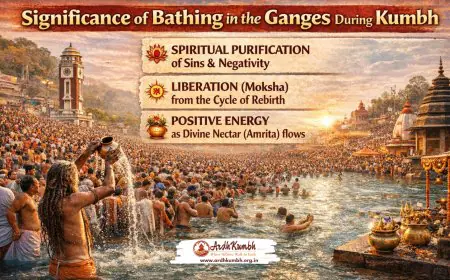
Let’s talk about Haridwar first. The name itself means “Gateway to God.” When the Ardh Kumbh happens here every six years, the entire city transforms into a living temple. The Har Ki Pauri ghat becomes the epicenter of devotion. Why does Haridwar get the Ardh Kumbh along with Prayagraj and not Nashik or Ujjain? Because in the six-year cycle between the full Kumbh rotations, the planets align twice at the Ganga’s bank before they align at the Godavari or Shipra. The spiritual logic goes like this: The nectar drops at Haridwar fell on a spot where the Ganga is still in her youthful form—fresh from the Himalayas, carrying maximum pranic energy. Many sadhus believe that bathing in the Ganga during Ardh Kumbh at Haridwar cleans not just your body but seven generations of your ancestors’ karma.
Another reason is geographical. Haridwar sits exactly where the Ganga breaks free from the Shivalik hills. In tantric geography, such threshold points are considered energy vortexes. So when Jupiter moves into the right constellation, this vortex amplifies the planetary energy many times over. The Ardh Kumbh at Haridwar attracts nearly 40 million devotees over a few months. That’s not just faith. That’s geometry, astronomy, and spirituality working together. The Kanwar pilgrims, the Naga sadhus, the Urs of Sabir Shah—all these streams of devotion merge at Haridwar during Ardh Kumbh because the place holds a frequency that no ritual can replicate elsewhere.
Prayagraj – The King of Sacred Confluences
Now let’s walk over to Prayagraj, formerly known as Allahabad. If Haridwar is the gateway, Prayagraj is the throne. The Triveni Sangam here is considered the holiest of all tirthas (crossing points). During Ardh Kumbh, which happens at Prayagraj every six years as well (alternating with Haridwar’s schedule), the energy is said to be twelve times stronger than a normal day at the Sangam. Why? Because here, the nectar didn’t just fall. According to some Purana versions, the longest pause in the chase between gods and demons happened right here. The Kumbh rested at Prayagraj for a longer moment, soaking the soil deeper with immortality.
Here’s something most people don’t realize. The Ardh Kumbh at Prayagraj coincides with the Magh Mela, a month-long fair that happens every year in January-February. But when the planets align for the six-year mark, the Magh Mela transforms into the Ardh Kumbh. The bathing dates become astrologically charged beyond regular days. The Sangam at Prayagraj has three rivers—visible Ganga and Yamuna, and invisible Saraswati. Yogis say the Saraswati flows in a parallel dimension. When you bathe during Ardh Kumbh, you’re not just washing in two rivers—you’re being cleansed in three realms: earth, mind, and spirit. That’s why millions walk hundreds of miles to reach Prayagraj. They know the place is irreplaceable.
Why Nashik and Ujjain Don’t Host the Ardh Kumbh
Now let’s clear up a common confusion. Nashik on the Godavari and Ujjain on the Shipra host the full Kumbh Mela every twelve years. But they do not host the Ardh Kumbh. Why? Because the six-year planetary alignment for these locations falls in a different celestial window that doesn’t match the half-cycle of the nectar’s energy rotation. Think of it as a clock with four points: Haridwar (12 o’clock), Prayagraj (3 o’clock), Ujjain (6 o’clock), and Nashik (9 o’clock). The full Kumbh visits each point once every twelve years. The Ardh Kumbh is the half-turn of the clock, hitting only the 3 o’clock and 9 o’clock positions—Prayagraj and Haridwar respectively. Ujjain and Nashik get their own halfway celebrations called Simhastha or Kumbh depending on the region, but the official Ardh Kumbh recognized by akharas and government happens only at Prayagraj and Haridwar.
This doesn’t make Nashik or Ujjain less sacred. Their nectar drops are just as real. But the astrological cycle for those places aligns with a different mathematical rhythm. Nashik gets its Kumbh when Jupiter enters Leo and the Sun enters Cancer. Ujjain celebrates when Jupiter enters Scorpio with the Sun in Cancer. These happen every twelve years but don’t produce a six-year intermediate event in the same way. So when you hear someone say “Ardh Kumbh happens at four places,” gently correct them. The scriptures and tradition are very clear. Only Prayagraj and Haridwar host the Ardh Kumbh every six years. The other two host the full Kumbh on their own twelve-year turn.
The Astrological Engine That Drives the Rotation
Let me break down the astrology in the simplest way possible. The Kumbh Mela timing follows Jupiter’s journey through the zodiac. Jupiter takes approximately one year to move through one sign and twelve years to complete a full circle. The Sun moves through all twelve signs in one year. The nectar spill happened at a specific celestial moment when Jupiter, Sun, and Moon were in certain positions. The Kumbh occurs when the same alignment repeats. But Ardh Kumbh occurs when Jupiter reaches the opposite point of its twelve-year cycle—which happens at six years. At that halfway mark, the planets align not at all four nectar spots, but only at the ones where the nectar’s frequency responds to half-cycle energy. That happens to be Prayagraj and Haridwar.
Imagine tuning a radio. Some stations come in clearly at certain frequencies. Others need a different bandwidth. The cosmic station of Ardh Kumbh only broadcasts to two receivers—Prayagraj and Haridwar. This isn’t discrimination. It’s physics of a different order. The Naga sadhus, Urdhwavahurs, Parivajakas, and Shri Mahants all follow this astrological calendar passed down orally for thousands of years. They don’t check Google Calendar to decide where to go. They look at the night sky. When Jupiter is ready, they pack their ash and trishuls and march to the sacred place that the stars have chosen.
Why Human Choice Cannot Override Cosmic Design
Some people ask, “Can we shift the Ardh Kumbh to another city to reduce crowding?” That question shows a beautiful modern logic but misses the entire point. The Ardh Kumbh is not a festival organized by a tourist board. It is a cosmic appointment that the universe keeps with certain coordinates on Earth. You cannot move it to Delhi or Mumbai or Varanasi because those places never received a nectar drop. The energy signature is not there. Sadhaks (spiritual practitioners) have tested this for centuries. They meditate at Haridwar during Ardh Kumbh and report kundalini shifts that don’t happen even at the same ghat on a normal day. This is measurable in subtle energy terms, even if our instruments haven’t caught up yet.
Another layer: The sacred places themselves are alive according to Hindu thought. The Ganga is not a river. She is a goddess. The Shipra is not just water. She is a mother. These deities agreed to host the Kumbh when Lord Brahma requested them after the nectar spill. So the contract is divine, not administrative. Breaking that contract would be like asking your heart to pump blood from your knee. It just won’t work. The Ardh Kumbh happens only at certain sacred places because reality itself is structured that way. We don’t choose the venue. The venue chooses us.
The Sacred Science of River Confluences and Planetary Gates
Let me take you deeper into why these specific river banks were chosen by the cosmos. Every sacred river in India has a personality. The Ganga is purity. The Yamuna is love. The Godavari is patience. The Shipra is wisdom. But only where nectar fell does the river also carry the frequency of immortality. At Prayagraj, the meeting of Ganga and Yamuna creates a third force—the Saraswati of knowledge. When you bathe at the Sangam during Ardh Kumbh, you’re not just taking a dip. You’re aligning your energy body with the three gunas (qualities of nature) and the three pathways to liberation. That’s why ancient texts call Prayagraj the king of tirthas.
At Haridwar, the Ganga is still carrying the Himalayan silence within her roar. The nectar drop here fell exactly where the river turns from north (toward the abode of gods) to south (toward the human world). That turn is a portal. During Ardh Kumbh, that portal widens. Pilgrims who bathe here with sankalpa (intention) report experiences ranging from healing of chronic diseases to spontaneous past-life memories. Is that superstition? Or is it science we haven’t mapped yet? Millions of testimonies over thousands of years suggest there’s something real happening. The place matters. The time matters. And the combination of the two during Ardh Kumbh creates a spiritual opportunity that doesn’t exist anywhere else at any other time.
What Happens to Your Soul When You Visit During Ardh Kumbh
If you ever get the chance to attend Ardh Kumbh at Prayagraj or Haridwar, you’ll notice something strange. The crowds are massive. The noise is overwhelming. The dust gets everywhere. And yet, deep inside, you’ll feel a stillness. That’s the place working on you. According to yogic science, each sacred place stores spiritual energy like a battery. During Ardh Kumbh, that battery discharges into every devotee who bathes in the river with faith. It doesn’t matter if you believe in mythology or not. The energy doesn’t need your permission. It simply flows where the cosmic plumbing directs it.
Many sadhus say that one holy dip during Ardh Kumbh equals thousands of years of meditation in a cave. Why? Because at that confluence of time and place, the veil between the physical and spiritual worlds becomes paper-thin. Your karmic debts can be burned faster. Your ancestors can finally find peace. Your future can take a turn you never expected. This is not magic in the cheap sense. This is technology older than history. The sacred places were designed by masters who understood earth energies, planetary cycles, and human consciousness better than any modern scientist. They left us the map. The Ardh Kumbh is one of the brightest dots on that map.
How to Experience Ardh Kumbh the Right Way
If this article has stirred something in you, and you want to experience the Ardh Kumbh yourself, here’s what you should know. First, check the dates for the next Ardh Kumbh at Prayagraj or Haridwar. The cycle runs every six years, alternating between the two. Second, go with patience. The crowds will test you. But that’s part of the sadhana (spiritual practice). Third, take the holy dip on the main bathing dates recommended by the akharas. Those dates are not random. They match the peak planetary alignment. Fourth, don’t just dip and leave. Sit on the ghat for at least an hour. Observe the sadhus. Listen to the mantras. Let the place breathe into you. Fifth, keep a sankalpa (a heartfelt intention) while bathing. It directs the energy to whatever needs healing in your life.
Avoid treating Ardh Kumbh like a tourist spot. Don’t spend all your time taking selfies or bargaining with vendors. The shopping can wait. The food can wait. The real prize is the dip in those nectar-charged waters at the exact moment the gods and planets agree to open the gate. That moment will change you. Not because of magic, but because you finally allowed yourself to be touched by something older and wiser than your daily worries.
The Eternal Return to Sacred Soil
So why does the Ardh Kumbh happen only at certain sacred places? Because those places carry nectar in their soil, stars in their sky, and gods in their water. No amount of human planning can replicate that. No new temple or man-made river can compete with that ancient charge. The cosmos made a contract with four riverbanks thousands of years ago. That contract holds today as firmly as the earth holds the moon. The Ardh Kumbh is not a tradition we keep alive. It is a force that keeps us alive. Every six years, Prayagraj and Haridwar remind us that some places are not chosen by maps but by destiny. And when you stand in those waters, under that planetary sky, you realize you’re not just visiting a place. You’re returning to a memory your soul never forgot.
Frequently Asked Questions