




























































How Ardh Kumbh Has Evolved Over the Centuries
Trace the 2000-year journey of Ardh Kumbh from ancient mythological gatherings to modern mega-festivals with technology and administration.
The Living River That Never Stood Still
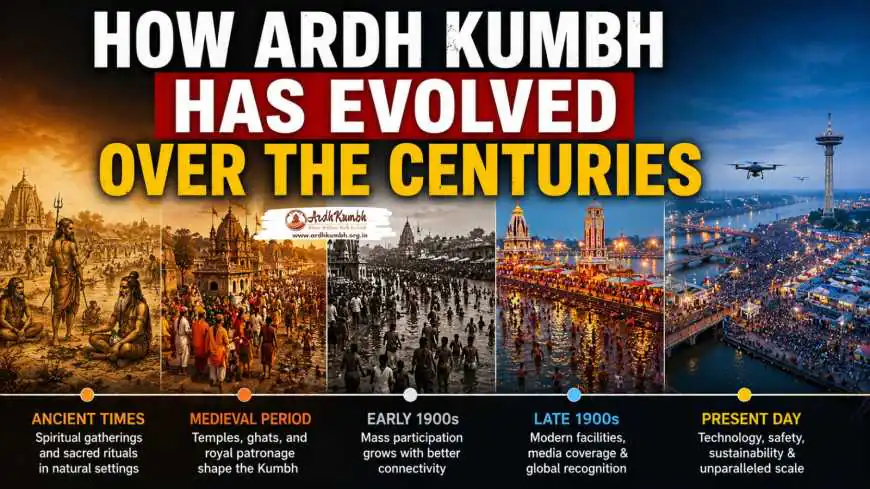
Let me ask you something. When you imagine the Ardh Kumbh, what picture comes to your mind? Millions of devotees. LED screens flashing safety messages. Concrete ghats with railings. Police drones buzzing overhead. Portable toilets lined up like soldiers. Now erase all of that from your mind. Go back two thousand years. No electricity. No tent cities with room service. No social media influencers broadcasting every holy dip. What did the Ardh Kumbh look like then? A handful of forest-dwelling sadhus meeting in silence by a wild river. A few villagers walking for months through dangerous forests just to stand where their ancestors stood. No tickets. No lost and found booths. No live telecasts. Just raw faith and raw nature. The Ardh Kumbh you see today is not the same animal that crawled out of ancient India. It has evolved – not once, not twice, but hundreds of times. It has survived invasions, famines, plagues, colonial rule, partition, terrorism, and pandemics. And with every survival, it has changed – sometimes for the better, sometimes for the worse, but always irreversibly. In this article, I will walk you through two thousand years of that evolution. Not as a dry historian, but as a storyteller who wants you to feel how the oldest gathering on Earth has learned to dance with time.
The Mythological Seeds – Before History Began
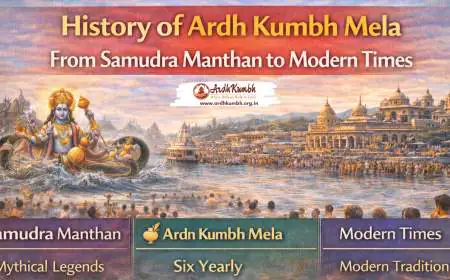
Before we talk about recorded history, we have to talk about memory. The Ardh Kumbh did not begin with a king’s decree or a temple inscription. It began with a story that generations carried in their bones – the Samudra Manthan. The churning of the ocean. The nectar that fell on four sacred spots. That story is not history in the way we use the word today. It is mythology – but mythology is not falsehood. It is truth wrapped in symbols. For thousands of years, before a single word was written on palm leaf or stone, mothers told their children about the pot of immortality. Those children grew up and walked to the river where the nectar had fallen. They bathed not because a calendar told them to, but because the stars told their grandfathers. That was the first evolution – from oral story to living ritual. No contracts. No committees. Just collective memory so strong that it survived the invention of writing, the rise and fall of empires, and the birth of every religion that came after. The Ardh Kumbh began as a whisper in the darkness of prehistory. That whisper is now a roar. But the roar still carries the original tune.
The Mauryan and Gupta Periods – When Kings Became Patrons
Fast forward to around 300 BCE. Emperor Chandragupta Maurya rules much of northern India. His grandson Ashoka will later become Buddhist and build stupas everywhere. But even Ashoka did not try to stop the Kumbh. Why? Because by then, the Kumbh – including the Ardh Kumbh – had become too big to ignore. Merchants, farmers, soldiers, and sadhus from all over the subcontinent were already making the journey to Prayag and Haridwar every six and twelve years. The Mauryan emperors saw the gathering not as a religious nuisance but as an economic engine. They built roads. They dug wells. They stationed soldiers to protect pilgrims from robbers. This was the first major evolution – the state getting involved. Then came the Gupta period (roughly 300-600 CE), often called the Golden Age of India. The Gupta kings were Hindus who actively sponsored the Kumbh. They built permanent ghats at Prayag and Haridwar. They donated land to akharas (monastic orders). They even standardized the astrological calculations that determine the dates of the Kumbh and Ardh Kumbh. This was huge. Before the Guptas, different regions used different calendars. After the Guptas, a priest in Tamil Nadu and a priest in Kashmir could agree on when the Ardh Kumbh should happen. That agreement – that standardization – is still used today. So when you check the dates for Ardh Kumbh 2027, thank a Gupta astronomer who lived fifteen hundred years ago.
The Medieval Period – Surviving Invasions and Iconoclasm
Now we enter a difficult chapter. From around 1000 CE onwards, northern India saw waves of invasion by armies that did not share the Hindu reverence for idols and temples. Mahmud of Ghazni raided temples for wealth. Later Sultanate rulers and Mughal emperors had a complex relationship with the Kumbh. Some, like Akbar, were tolerant and even participated in Hindu festivals. Others, like Aurangzeb, tried to suppress what they saw as idolatry. So how did the Ardh Kumbh survive? By going underground – literally and metaphorically. During dangerous periods, the Naga sadhus – who are also warriors – would escort pilgrims through forests to avoid detection. The bathing would happen at night instead of dawn. The gatherings would be smaller, quieter, and shorter. The akharas kept records hidden in caves. The tradition did not die because it was decentralized. There was no central Kumbh office that could be burned down. There were only thousands of small groups who remembered the dates and passed them down. This decentralization was a brilliant evolution. It made the Ardh Kumbh indestructible. You could kill a king. You could burn a temple. But you could not kill every sadhu or burn every memory. The Ardh Kumbh learned to hide and wait. And when the danger passed, it emerged again – scared, wounded, but alive.
Trending Guides Now

Who Are Naga Sadhus and Why They Lead Kumbh
Read Guide →
Significance of Bathing in the Ganges During Kumbh Mela Explained
Read Guide →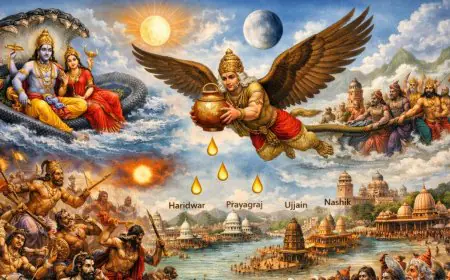
What Is the Story Behind the Ardh Kumbh Mela?
Read Guide →
The Untold Stories of Har Ki Pauri
Read Guide →
Best Routes to Reach Haridwar for Ardh Kumbh Mela
Read Guide →
Ardh Kumbh 2027 Dates (Official) - Haridwar Snan Schedule
Read Guide →
How Ardh Kumbh Stayed Relevant Over Centuries
Read Guide →
Why Early Mornings Are Sacred
Read Guide →The British Era – When the Empire Tried to Tame the Mela
The British East India Company and later the British Raj had a love-hate relationship with the Kumbh Mela. On one hand, they were horrified by the crowds, the naked sadhus, and the disease outbreaks. On the other hand, they were fascinated by the scale and could not stop it. The British tried everything. They tried to ban the Naga sadhus from carrying weapons. They tried to regulate the bathing dates to prevent stampedes. They built permanent infrastructure – roads, bridges, police stations – to manage the chaos. They even introduced the first ticket system for ferry rides across the Ganga. But the biggest evolution during the British era was documentation. The British were obsessed with records. They wrote reports on everything – how many pilgrims came, how many died from cholera, how much money changed hands. Those reports are now invaluable for historians. Because of the British, we know that the Kumbh and Ardh Kumbh of the 19th century were smaller, deadlier (due to disease), and less regulated than today. We also know that the British accidentally strengthened the Kumbh by building infrastructure. The roads and railways they built for colonial trade made it easier for pilgrims to travel. So in a strange irony, the empire that wanted to control the Kumbh ended up expanding it. By the time India gained independence in 1947, the Ardh Kumbh was no longer a local gathering. It was a national phenomenon – thanks partly to the unintentional help of the British.
Post-Independence – The Birth of the Modern Mega-Festival
After 1947, the Indian government faced a huge question. What to do with this massive gathering that happened every six years at Prayagraj and Haridwar? The first few decades were about survival. Partition had displaced millions. India was poor. Infrastructure was weak. The Kumbh and Ardh Kumbh continued, but poorly managed. Stampedes happened. Disease outbreaks were common. Then came 1989 – a turning point. The government decided to treat the Ardh Kumbh like a national project. They created a special planning committee. They brought in army engineers to build temporary bridges. They set up thousands of toilets – a revolution because before that, open defecation was a major health hazard. They introduced public address systems to manage crowds. They trained volunteers in disaster response. The results were dramatic. Deaths from stampedes and disease dropped sharply. The Ardh Kumbh began to look less like a survival challenge and more like a organized festival. By the 1990s, the Ardh Kumbh had become a media event. Television crews came. Newspapers ran special editions. Foreign tourists started noticing. The evolution from medieval survival to modern spectacle was complete. Today, the Ardh Kumbh is a temporary city of tents, roads, hospitals, police stations, electricity grids, and water treatment plants – all built in weeks and dismantled just as fast. That is engineering that would have stunned even the British.
The Digital Revolution – How Technology Changed Everything
Let me tell you about the biggest change in the last twenty years. Smartphones. Internet. Social media. In 2001, at the Ardh Kumbh in Prayagraj, few people had mobile phones. In 2019, at the Ardh Kumbh in Haridwar, everyone had a smartphone. What did that do to the experience? Everything. Pilgrims now book their tents online. They check real-time crowd updates on apps. They track the Naga sadhus through YouTube live streams. They share their holy dip on Instagram before the water has dried on their skin. This is a double-edged sword. On one hand, technology has made the Ardh Kumbh safer and more accessible. You can now find your lost father using a WhatsApp location. You can avoid the most crowded ghats using a government app. You can learn the bathing dates without finding a priest. On the other hand, technology has stolen something. Silence. Presence. The ability to just stand at the Sangam without checking your phone. The Ardh Kumbh is now broadcast to billions who never leave their homes. That is amazing for reach. But is it the same as being there? No. The evolution continues. AI is now being used to predict crowd movements. Drones monitor for stampede risks. Facial recognition helps find missing persons. The ancient gathering is now a tech marvel. Whether that is good or bad depends on who you ask. But it is undeniable that the Ardh Kumbh of 2027 will look nothing like the Ardh Kumbh of 2001 – let alone 1001.
The Changing Role of Naga Sadhus – From Warriors to Celebrities
Let me focus on one group that has changed more than any other – the Naga sadhus. A thousand years ago, the Naga sadhus were fierce warriors. They protected the Kumbh from invaders. They carried swords, spears, and trishuls. They bathed first because they were the first line of defense. Today, the Naga sadhus still bathe first. But their role has changed. They are now celebrities. Cameras follow them. Foreign photographers pay thousands of dollars for a portrait. Some Naga sadhus have millions of YouTube subscribers. They sell merchandise – t-shirts, posters, even ash from their bodies. This evolution breaks my heart a little – and also makes me smile. Because the Naga sadhu has adapted. When warriors were no longer needed, they became teachers. When teachers were no longer enough, they became influencers. Is it less sacred? Maybe. But is it survival? Absolutely. The Naga sadhus are still there at every Ardh Kumbh. They still smear ash on their bodies. They still fast for months. They still meditate for hours. But now they also pose for selfies. That is not corruption. That is evolution. And evolution is never pure. It is always messy. The Naga sadhus of 2027 will be different from the Naga sadhus of 1927. And that is fine. Because the alternative to evolution is extinction. And the Naga sadhus – like the Ardh Kumbh itself – have chosen life.
How the Pilgrim Demographics Have Shifted Over Time
Who comes to the Ardh Kumbh has changed as much as how they come. A thousand years ago, the pilgrim was usually old, rural, male, and poor. Travel was dangerous. Only those with strong faith – or nothing to lose – made the journey. Women came rarely. Children came almost never. Fast forward to today. The modern pilgrim is young, urban, middle-class, and often female. Women now lead prayer groups. Teenagers come with backpacks and water bottles. Foreigners from Russia, Brazil, China, and America come to study the phenomenon. Families with small children and elderly grandparents come together – something unthinkable a few centuries ago when robbers and wild animals made the roads deadly. What caused this shift? Safety and infrastructure. Paved roads. Railway connections. Budget airlines. Police protection. Medical facilities. When the journey became safer, more types of people could afford to make it. The Ardh Kumbh has democratized. It is no longer just for the renunciate or the desperate. It is for the tourist, the yogi, the curious, and the spiritual seeker of any age and gender. This democratization is one of the greatest evolutions of the Ardh Kumbh. It has transformed from an elite gathering of warrior monks into a people’s festival – messy, loud, chaotic, but beautifully inclusive.
The Environmental Evolution – From Pristine to Polluted to Conscious
Let me be honest about something uncomfortable. The rivers of the Ardh Kumbh – the Ganga, the Yamuna, the Godavari, the Shipra – were once pristine. A thousand years ago, you could drink from them without fear. Today, you cannot. Industrial waste. Sewage. Plastic. The rivers are sick. The Ardh Kumbh – with its millions of pilgrims – makes the sickness worse. Soap, detergent, food waste, human waste, plastic bottles – all of it flows into the holy waters. This is the dark side of evolution. The ancient Kumbh did not have to worry about pollution. The modern Ardh Kumbh has made pollution a central crisis. But here is the hopeful part. In the last twenty years, a new evolution has begun – environmental consciousness. The government now sets up sewage treatment plants specifically for the Kumbh. Volunteers collect plastic from the river banks. Sadhus have started campaigns to stop the use of plastic at the Mela. Pilgrims are now aware that their holy dip should not harm the river they revere. This consciousness is still young. It is not enough. But it is a beginning. The Ardh Kumbh has evolved from ignoring pollution to fighting it. The next evolution must be from fighting it to healing it. Will that happen by 2027? Probably not fully. But the seed has been planted. And seeds have a way of growing at sacred places.
The Commercial Evolution – From Barter to Billion-Rupee Economy
Let me talk about money – because money always changes everything. A thousand years ago, pilgrims brought rice, ghee, or cloth to offer or barter. There was no cash economy at the Kumbh because cash itself was rare. Sadhus lived on alms. Vendors traded goods for food. Fast forward to today. The Ardh Kumbh is a billion-rupee economy. Tent companies bid crores for prime locations. Food stalls pay lakhs for permits. Brands sponsor sadhus – yes, you read that right. Corporate logos now appear next to spiritual symbols. Influencers are paid lakhs to post from the Mela. Is this disgusting? Some say yes. Others say practical. Because millions of people need food, water, toilets, tents, medicine, and transportation. Someone has to pay for that. The government pays some. But private business pays a lot. The Ardh Kumbh has evolved from a barter fair to a capitalist marketplace – complete with advertising, sponsorships, and profit margins. This evolution makes many traditionalists uncomfortable. But the Ardh Kumbh has always been a reflection of Indian society. And Indian society today is capitalist. So the Mela reflects that. The challenge is to keep the commercialism from drowning the sacred. That balance is still evolving. And it will continue to evolve in 2027, 2033, and beyond.
What Has Not Changed – The Unbroken Thread
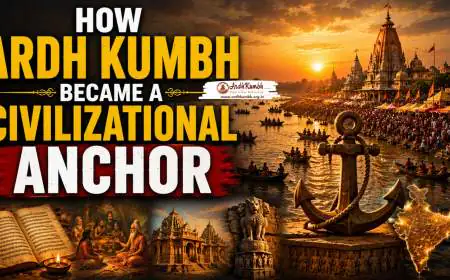
After all this talk of change, let me end with what has not changed. The faith of the pilgrim who walks for weeks just to stand at the river. The tear of the old woman as she dips her grandchild in the water. The silence of the Naga sadhu as he meditates at dawn. The smell of incense mixed with sweat and hope. The sound of a million hearts beating as one. These things are older than history. They have survived kings, empires, invasions, famines, plagues, colonialism, pollution, commercialism, and pandemics. They will survive AI, drones, and social media. Because they are not external. They are internal. The Ardh Kumbh has evolved in every visible way – but in its invisible core, it is still the same gathering that happened the first time a human being stood at the Sangam and felt something larger than themselves. That thread has never been broken. And it never will be. So when you go to Ardh Kumbh 2027, look at the LED screens and the concrete ghats and the police drones. Then close your eyes. What you feel is what your ancestors felt two thousand years ago. That is the real Ardh Kumbh. And that has not evolved one bit.
Frequently Asked Questions